

Testing Basswood Moisture Content Before You Cut (2026 Protocol)
The practical moisture range for laser-cutting basswood is roughly 6-10%, and testing before you cut catches a problem batch before you commit a sheet to a precision press-fit job. This guide walks through an actual testing protocol – where to place the probe, how to read thin plywood, and what the numbers mean – not just a target to memorize.
By Mike Dolan ·
Quick Answer: Basswood moisture content for laser cutting should be roughly 6-10%; test thin sheets with a moisture meter on the face in several spots, focusing on relative consistency between batches rather than one precise number.
| Material | Engraving Contrast | Cut Ease | Smoke / Odor | Cost | Beginner Score |
|---|---|---|---|---|---|
| Basswood (3 mm) | ★★★★★ | Excellent – 1 pass | Low | $ | ★★★★★ |
| Baltic Birch Plywood | ★★★★ | Good – 2-3 passes | Medium | $$ | ★★★★ |
| MDF | ★★★ | Good – 1-2 passes | High (formaldehyde) | $ | ★★ |
| Pine / Soft Plywood | ★★★ | Poor – resin deposits | Medium-High | $ | ★★ |
The Target Range Is 6-10%, Not One Magic Number – Here’s Why Sources Disagree
The practical moisture range for laser-cutting basswood is roughly 6-8% for kiln-dried interior material, with 6-10% being a workable acceptable band. Above roughly 12%, the wood starts behaving like construction-grade lumber – more prone to warping, inconsistent char, and dimensional shift after cutting.
Why don’t all sources agree on one number? Because different end uses, climates, and product specs call for different targets. A furniture maker in Arizona aims lower than a hobbyist in coastal Washington. Plywood manufacturers kiln-dry to different specs than solid lumber mills.
I learned this the hard way after cutting a batch of press-fit boxes that fit perfectly the day I cut them, then wouldn’t assemble two weeks later. The joints had tightened up as the wood gave up moisture to my dry workshop air. Testing beforehand catches that mismatch early – it’s the incoming-QA step that helps you avoid why recut parts don’t fit problems down the line.
You’re not chasing a single universal number here. You’re checking that the batch you’re about to commit to a precision job falls somewhere in that 6-10% band and matches what you’ve successfully cut before. Relative consistency between batches matters more than hitting one exact percentage.
How to Actually Test a 3mm Basswood Sheet: Face, Edge, and How Many Spots
Let the sheet acclimate in your workshop for at least a few hours before you test – pulling a sheet straight from a sealed pack or a cold garage gives you a snapshot of where it was, not where it is now.
Test the face in several spots: center plus each quadrant. Avoid obvious voids, knots, or patches – you’re sampling the bulk material, not hunting for defects.
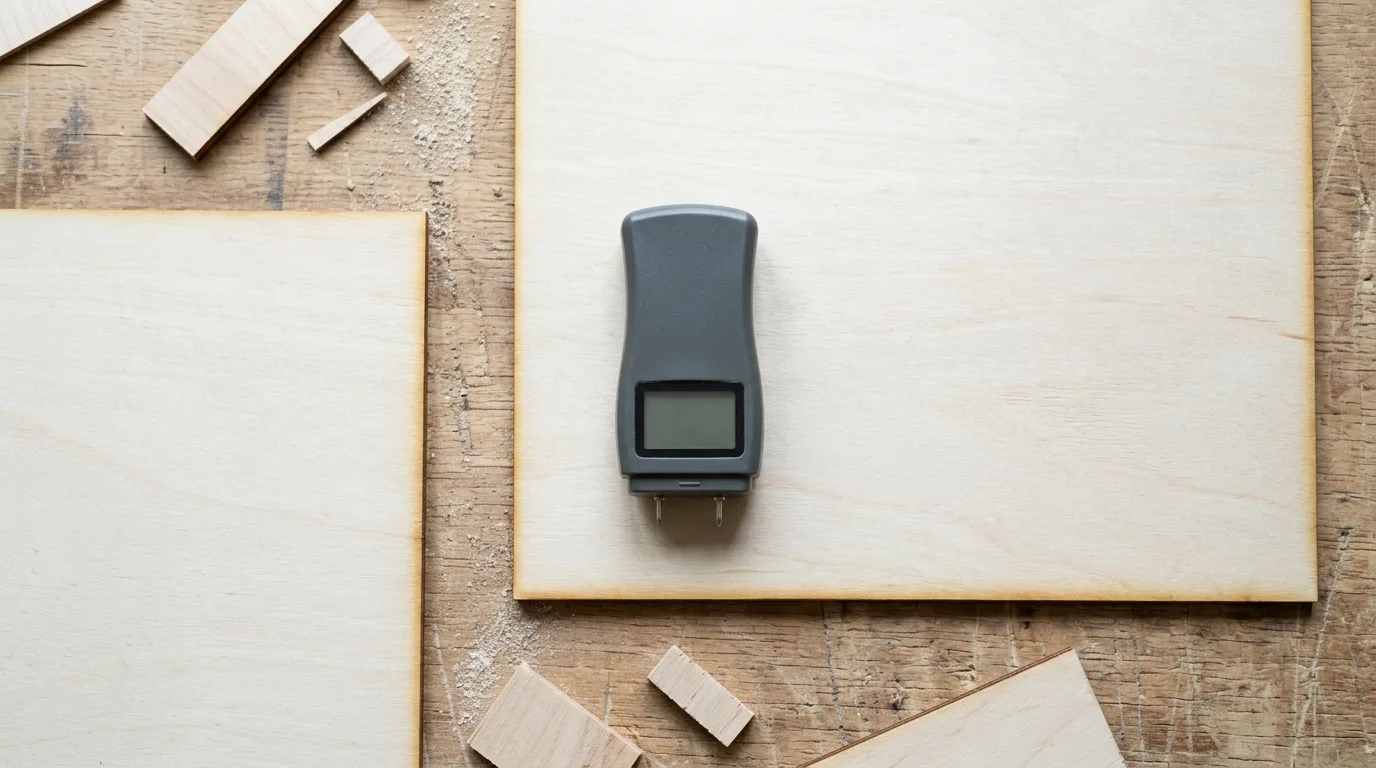
For pin-type meters, insert the pins perpendicular to the face and check both sides of the sheet. The reading can vary between face and back, especially if one side dried faster during manufacturing.
For pinless meters, make sure the sensing pad is fully supported on a flat, smooth area – if the pad bridges a void or hangs off an edge, you’ll get a low or inconsistent reading.
You’re looking for an affordable hobby-grade pin or pinless moisture meter. Both types work; pin meters give you a more localized reading at the probe tips, while pinless meters average a slightly larger area under the pad.
I started testing after a batch that looked identical sheet-to-sheet gave wildly different char – some edges barely brown, others nearly black, same settings. Turned out moisture varied by several percentage points across the pack. Testing caught it before I burned through the whole order on a press-fit commission.
Why Thin Plywood Gives Messier Readings Than Solid Lumber (and What to Do About It)
Pinless meters can under-report if the sheet is thinner than the meter’s calibrated measuring depth – most hobby meters are tuned for standard framing lumber, not 3mm plywood. You might see a reading a point or two lower than reality.
Pin-type meters can give noisy readings near glue lines or voids. Plywood is layers and adhesive, not one homogeneous block, so adjacent test points sometimes disagree more than they would on solid basswood.
The practical takeaway: focus on relative consistency across multiple points on a sheet and between batches, not treating one exact reading as a perfectly precise absolute number. If all five spots read 7-8%, you’re good. If one corner reads 10% and the opposite reads 6%, that sheet is uneven – use it for scrap test cuts, not precision work.
This isn’t a precision instrument giving you lab-grade data. It’s a consistency check: does this batch behave like the last one, or do I need to adjust my expectations before I commit a full sheet to a job?

Does Moisture Content Actually Affect Laser Cutting, or Is This Overkill for a Hobby?
Yes, moisture content affects cut quality, char intensity, and dimensional stability after cutting. Wood with higher moisture takes more energy to vaporize, which translates to slower cuts, darker char, and edges that shift as the material equilibrates post-cut.
That said, for a casual one-off hobby project you can probably skip the meter. Where testing earns its keep is precision press-fit work and troubleshooting inconsistent results batch to batch.
I ran into this the hard way on a batch of architectural models. Same settings, same machine, but some sheets came out with barely-there brown edges while others looked nearly black. Visual quality was fine on all of them, but the inconsistent char drove me nuts because it read as sloppy craftsmanship.
Tested the whole batch after the fact and found moisture variance of several percentage points sheet to sheet. Once I switched to a supplier with tighter kiln-dried consistency, the problem disappeared. If your cuts look good and fit together, you’re fine – but if you’re chasing why one sheet behaves differently than the last, moisture is the first variable to measure.
Testing vs. Storage: Two Different Jobs, Both Matter
Testing and storage are complementary tools, not substitutes for each other. A moisture meter tells you what you’re working with right now. Good acclimation and storage habits keep that number stable so you don’t have to test every sheet.
If you’re already storing and acclimating basswood sheets properly in a controlled environment, you’ll rarely need to pull out the meter. Test when you’re unsure about a new supplier, troubleshooting a problem batch, or working on a project where dimensional precision matters more than usual.
Think of testing as incoming QA and storage as process control. The meter catches the outliers; proper storage prevents them from happening in the first place.
Crafteker Basswood: Consistent Kiln-Dried Range, Less Time Second-Guessing
Crafteker 3mm basswood sheets are supplied at a consistent kiln-dried moisture range, which means you spend less time testing and second-guessing individual sheets before you commit them to a precision job. Laser-grade, void-free, 12×12 inch, pre-sanded on both faces.
Available in three pack sizes: 3-pack $12.99, 5-pack $15.97, or 12-pack $24.99 (about $2.08/sheet, best value). The uniform quality batch to batch is why these settings guides work reliably without re-tuning every time you open a new pack.
Ready to cut? Get the wood that works with these settings:
→ Buy Crafteker 12-Pack Basswood Sheets on Amazon – $24.99
Also available: 5-pack ($15.97) · 3-pack ($12.99)
Frequently Asked Questions
What is the ideal moisture content for basswood used in laser cutting?
Roughly 6-8% is commonly targeted for kiln-dried interior material, with 6-10% a workable practical range. Sources vary because they target different end uses, climates, and product specs – there’s no single universal number, but staying below around 12% keeps you clear of construction-grade behavior.
How do I test a thin basswood sheet with a moisture meter?
Let the sheet acclimate in your workshop first, then test the face in several spots – center plus each quadrant – avoiding obvious voids or defects. For pin-type meters, insert perpendicular to the face and check both sides; for pinless meters, make sure the sensing pad is fully supported on a flat, smooth area.
Are moisture meter readings on thin plywood accurate?
Less precise than on solid lumber. Pinless meters can under-report if the sheet is thinner than the meter’s calibrated measuring depth, and pin-type meters can give noisy readings near glue lines or voids. Focus on relative consistency across multiple points and between batches, not treating one exact reading as gospel.
Does moisture content really matter for laser cutting basswood?
Yes – it affects cut quality, char intensity, and dimensional stability after cutting. It matters most for precision press-fit work or when you’re troubleshooting inconsistent results batch to batch. For a casual one-off hobby cut, you can probably skip the meter. I spent an afternoon chasing settings on a job lot before I tested the sheets – turned out three were fine at 7%, two were pushing 11%, and the char was all over the map.
Where can I buy basswood sheets with consistent moisture content?
Crafteker on Amazon: 3-pack $12.99, 5-pack $15.97, or 12-pack $24.99 ($2.08/sheet best value). 3mm, 12×12 inch, laser-grade, void-free, supplied at a consistent kiln-dried moisture range so you spend less time testing individual sheets.
About the author: Mike Dolan is a laser maker and wood materials specialist with 8+ years cutting basswood, birch, and MDF on diode and CO₂ machines. He tests every Crafteker basswood batch before listing.
I grabbed a cheap pin-type meter after getting weirdly inconsistent char on a batch – some sheets dark, some barely brown, same settings. Tested a few spots on each sheet instead of trusting one reading, turned out moisture was all over the place. Switched to Crafteker and haven’t had to worry about it since, their sheets read pretty consistent right out of the pack.