

Pricing Blanks vs Finished Basswood: Saturated Etsy 2026
When your exact basswood SKU already has 20+ near-identical listings on Etsy, blanks compete mainly on raw price and volume because buyers are often other makers, while finished products have more room to price above commodity through personalization and branding – but matching the lowest competitor price erodes your margin toward zero once fees, materials, and labor are actually counted. You’ll get a pricing framework and practical differentiation levers here, not a magic price number.
By Mike Dolan ·
Quick Answer: Pricing blanks vs finished basswood products on Etsy in saturated categories: blanks compete on raw price since buyers add their own value, finished goods hold higher prices through differentiation, never chase the bottom blindly.
| Material | Engraving Contrast | Cut Ease | Smoke / Odor | Cost | Beginner Score |
|---|---|---|---|---|---|
| Basswood (3 mm) | ★★★★★ | Excellent – 1 pass | Low | $ | ★★★★★ |
| Baltic Birch Plywood | ★★★★ | Good – 2-3 passes | Medium | $$ | ★★★★ |
| MDF | ★★★ | Good – 1-2 passes | High (formaldehyde) | $ | ★★ |
| Pine / Soft Plywood | ★★★ | Poor – resin deposits | Medium-High | $ | ★★ |
Why Blanks and Finished Goods Need Different Pricing Logic in a Saturated Category
Blanks compete on raw price and volume because the buyer is usually another maker or reseller who plans to add their own value. They want consistent quality at the lowest per-unit cost, and they’ll skip your listing if the next one down is even a dollar cheaper.
Finished products live in a different world. You’ve already added the design work, the personalization, the branding, the photography. That means you can hold a price above commodity level even when the category is crowded, because you’re no longer selling a raw input.
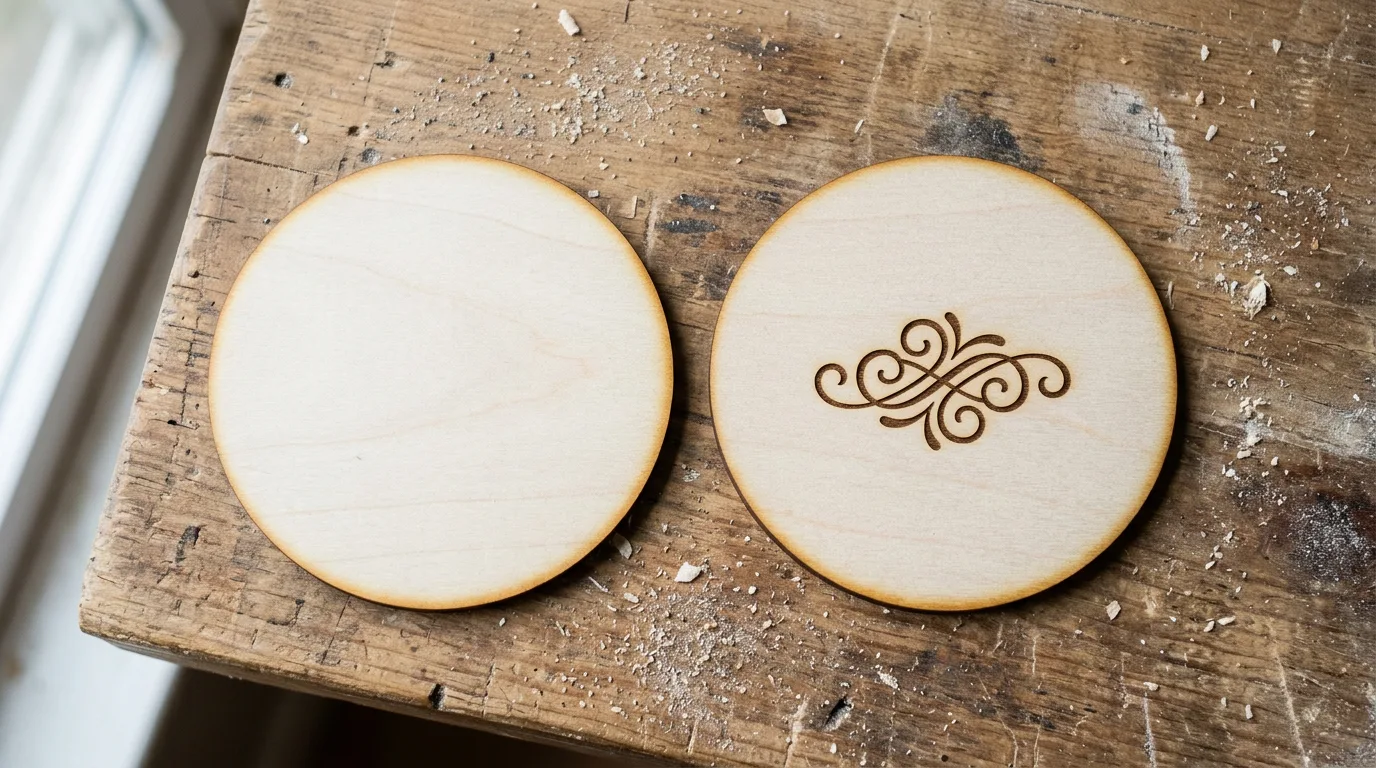
I sold identical 4-inch round laser engraving wood blanks at one point: plain unfinished circles for other makers, and personalized ornaments with names and dates laser-cut into the same shape. The blanks moved slowly at commodity pricing. The finished ornaments sold faster at more than three times the blank price, same basswood, same cut time.
The lesson stuck: if you’re selling blanks in a saturated category, you’re competing mainly on price and reliability. If you’re selling finished work, you have levers to pull that don’t involve racing to the bottom. Knowing which game you’re in changes every pricing decision you make, and understanding your real per-unit cost – materials, laser time, finishing labor, packaging, and the actual fee percentage after Etsy takes its cut – tells you whether a competitor’s price is sustainable or just a temporary loss leader you shouldn’t chase.
Know Your Real Numbers Before You Price Against 20 Competitors
Before you react to competitor prices, know your real all-in cost. Materials are the easy part – you can see Crafteker’s $2.08/sheet and calculate from there. But you also need laser time per unit, finishing labor if you’re sanding or coating, packaging supplies, and the real Etsy fee breakdown that shows your actual net after the platform takes its cut.
Without this number, you can’t tell if a competitor’s listing price is sustainable or if they’re operating at a loss. I’ve seen shops underprice ornaments in a crowded category, then vanish a few months later because the math never covered their time. Calculate your floor first, then decide what you’re willing to accept above it.
Write down your per-unit cost on a sticky note and keep it visible. When you’re tempted to match a competitor’s price, check the note first. If their number is below your cost, let them race to the bottom alone – you can’t win a game where the prize is negative margin.
Why Racing to the Bottom Usually Backfires in a Saturated Category
Matching the lowest listed price in a saturated category erodes margin toward zero once real costs are counted. Many rock-bottom-priced shops are effectively unprofitable and don’t last. You undercut a listing, someone else undercuts you back, and the cycle keeps going until you’re working for less than minimum wage.
The alternative is accepting lower volume at a price that actually protects margin. I chased a competitor’s price down twice on a set of basswood coasters, realized the math no longer covered materials and my time, and backed off instead of chasing a third cut. Fewer sales came in that month, but the profit per sale held up – and I didn’t burn out trying to fill a pile of orders at break-even.
Some sellers price low intentionally as a customer-acquisition strategy and plan to upsell later. Others simply haven’t done the math yet. Either way, you don’t have to follow them. Compete on something other than the lowest number, or you’ll end up working harder for less money in a category where 20 other shops are doing the same thing.

Differentiation Levers That Let You Hold a Defensible Price
When you can’t win on price alone, compete on something else. These levers let you hold a defensible margin even when 20 other shops are selling nearly identical shapes:
- Personalization and custom text: The same blank shape, laser-engraved with a name or custom text, commands a noticeably higher price than the plain version. Buyers pay for the customization, not the wood.
- Superior photography and cohesive branding: Clean, well-lit product shots and a consistent visual style signal quality. I’ve watched identical products sell at different prices purely because one shop’s photos looked more trustworthy.
- Target a specific sub-audience: Instead of “basswood ornament,” sell “pet memorial ornament” or “hiking trail marker.” Narrower targeting means fewer direct competitors and buyers who value the specificity.
- Bundle multiple items into a set: A single coaster competes with a huge pile of near-identical listings. A set of coasters with a holder competes with far fewer and justifies a higher per-unit price.
- Faster or more reliable shipping: Two-day dispatch beats five-day dispatch. Consistent delivery times earn repeat buyers who stop price-shopping every order.
- Distinctive finish or coating: A clear coat, hand-painted detail, or walnut stain transforms a commodity blank into something visibly different. The finish is the differentiation.
None of these guarantee higher sales, but each one gives you a reason to hold your price when someone undercuts you by fifty cents.
Connecting Pricing Strategy Back to Your Blanks-vs-Finished Model Choice
This pricing framework applies whether you’ve chosen to sell blanks or finished products. If you’re still deciding between the two models, choosing between blanks and finished products walks through the tradeoffs in detail.
That article helps you pick the model. This one helps you price within it once the category gets crowded and the lowest-price competitor starts to look tempting.
The math doesn’t change: know your real cost, decide what margin you need to stay in business, and use differentiation to defend that price instead of chasing every undercut. I dropped my prices twice before I figured that out – ask me how long it took to realize I was working for free.
Crafteker Basswood: Consistent Cost Input for Predictable Pricing Math
When you’re calculating margin down to the cent, inconsistent material cost wrecks your pricing model. Crafteker 3mm basswood sheets – 12×12 inch, laser-grade, void-free – give you predictable per-unit material cost because thickness and quality stay consistent sheet to sheet.
That consistency matters when you’re pricing against saturated competition and can’t afford surprise voids or warped sheets that waste a cut. Three pack sizes: 3-pack $12.99, 5-pack $15.97, 12-pack $24.99 (about $2.08/sheet, best value). Your material cost input stays stable, so your pricing math stays reliable.
Ready to lock in predictable material costs?
→ Buy Crafteker 12-Pack Basswood Sheets on Amazon – $24.99
Also available: 5-pack ($15.97) · 3-pack ($12.99)
Frequently Asked Questions
Should blanks and finished basswood products be priced the same way?
No. Blanks compete mainly on raw price and volume because buyers are often other makers who add their own value. Finished products have more room to price above commodity levels through personalization, design, and brand value even when the category is crowded.
How do I know if a competitor’s low price is actually sustainable?
Calculate your own real all-in cost first – materials, laser time, packaging, and fees. Once you know that number, you can judge whether a competitor’s price still covers those costs or if they’re likely operating at a loss. Many rock-bottom shops don’t last.
Is it worth matching the lowest price in a saturated Etsy category?
Usually not. I chased a competitor’s price down twice last year, realized the math no longer covered materials and time, and backed off instead of chasing a third cut. Accepting lower volume at a defensible price beats racing to zero margin.
How can I compete without just lowering my price?
Personalization, better photography and cohesive branding, targeting a specific sub-audience, bundling multiple items into a set, faster shipping, and distinctive finishes all let you hold a price instead of racing competitors to the bottom. You’re competing on something other than the lowest number.
Where can I buy consistent basswood to keep my cost math predictable?
Crafteker on Amazon: 3-pack $12.99, 5-pack $15.97, 12-pack $24.99 – works out to $2.08 per sheet at best value. Consistent thickness and quality sheet to sheet so your per-unit material cost stays predictable when you’re doing careful pricing math.
About the author: Mike Dolan is a laser maker and wood materials specialist with 8+ years cutting basswood, birch, and MDF on diode and CO₂ machines. He tests every Crafteker basswood batch before listing.
I dropped my basswood ornament prices twice last year trying to keep up with competitors until I realized the math didn’t cover my time anymore. Switched to offering personalized names on the same shapes and held a higher price – way better than chasing the bottom. Crafteker sheets keep my material cost predictable so at least that side of the equation stays stable.