
Basswood vs Poplar for Laser Cutting: Which Wins 2026
Basswood consistently delivers cleaner cuts, higher engraving contrast, and better repeatability than poplar across CO2 and diode lasers in 2026. This guide breaks down the material science, laser behavior, real-world results, and cost differences so you can choose the right wood for your project and master the settings that produce gallery-quality edges.
By Mike Dolan ·
Quick Answer: Basswood vs poplar for laser cutting: basswood wins on consistency and finish quality; poplar suits budget learning and low-cost production runs.
| Material | Engraving Contrast | Cut Ease | Smoke / Odor | Cost | Beginner Score |
|---|---|---|---|---|---|
| Basswood (3 mm) | ★★★★★ | Excellent – 1 pass | Low | $ | ★★★★★ |
| Baltic Birch Plywood | ★★★★ | Good – 2-3 passes | Medium | $$ | ★★★★ |
| MDF | ★★★ | Good – 1-2 passes | High (formaldehyde) | $ | ★★ |
| Pine / Soft Plywood | ★★★ | Poor – resin deposits | Medium-High | $ | ★★ |
| Poplar | ★★★ | Fair – density varies | Low-Medium | $ | ★★★ |
Why Is Basswood the Best Wood for Laser Cutting?
Basswood is the best wood for laser cutting because its low resin content, uniform grain, and consistent density produce clean kerfs and high-contrast engravings with minimal post-processing. According to USDA Forest Products Laboratory data, basswood ranks among the lowest-resin domestic hardwoods, making it ideal for both CO2 and diode laser systems.
Whether you’re dialing in basswood laser cutting settings for the first time or scaling a production run, this material rewards you with repeatable results. Its pale ivory surface also makes it one of the top choices for laser engraving wood blanks where contrast and detail both matter.
- Low resin content – minimal charring and residue on cut edges means less lens contamination and fewer cleaning cycles between jobs, keeping your beam focused and your output consistent.
- Consistent density – the same settings work batch after batch without retuning; no surprise incomplete cuts or blowout from density variation within the sheet.
- Minimal char – produces clean cut edges with air assist enabled; the pale surface stays bright rather than darkening with scorching around the ke
How to Laser Cut Basswood: Prep, Settings & Best Practices
All settings below are for Crafteker 3mm basswood sheets (12×12 inch, laser-grade). Use the Laser Settings Calculator to fine-tune for your specific unit if results differ.
Machine Cut Speed Cut Power Passes Engrave Speed Engrave Power Air Assist 5W Diode Laser 3-5 mm/s 100% 2-3 60-80 mm/s 35-40% Strongly Recommended 10W Diode Laser 6-8 mm/s 100% 1-2 80-150 mm/s 40-50% Strongly Recommended 20W Diode Laser 8-12 mm/s 90-100% 1-2 150-300 mm/s 40-60% Strongly Recommended 40W Diode Laser 10-15 mm/s 85-95% 1-2 200-400 mm/s 45-65% Strongly Recommended 40W CO2 Laser 20-35 mm/s 55-65% 1 200-400 mm/s 45-65% Required 60W CO2 Laser 30-50 mm/s 50-60% 1 250-450 mm/s 40-55% Required Note: Air assist is strongly recommended for all diode lasers and required for CO2 units. It clears combustion gases from the kerf in real time, protecting the lens from resin deposits and preventing edge charring that reduces contrast. Always run a 1×1 inch test cut before starting a full job on a new batch of material.
Before loading any sheet, lightly sand the surface to remove dust, then apply painter’s tape to the back face to catch residue and simplify cleanup. Flat material positioning is non-negotiable – even a 1mm bow can cause incomplete penetration across the sheet.
The Crafteker 12-pack basswood sheets are purpose-built for both CO2 and diode lasers – 12×12 inch, 3mm, laser-grade, void-free. $24.99 for 12 sheets ($2.08/sheet).
Step-by-Step: Achieving Clean Cuts on Basswood
Clean cuts on basswood come down to three things: accurate focus, consistent air assist, and flat material. Follow these six steps for reliable, gallery-quality results every time.
- Verify
How Does Your Laser Compare to Other Machines for Basswood?
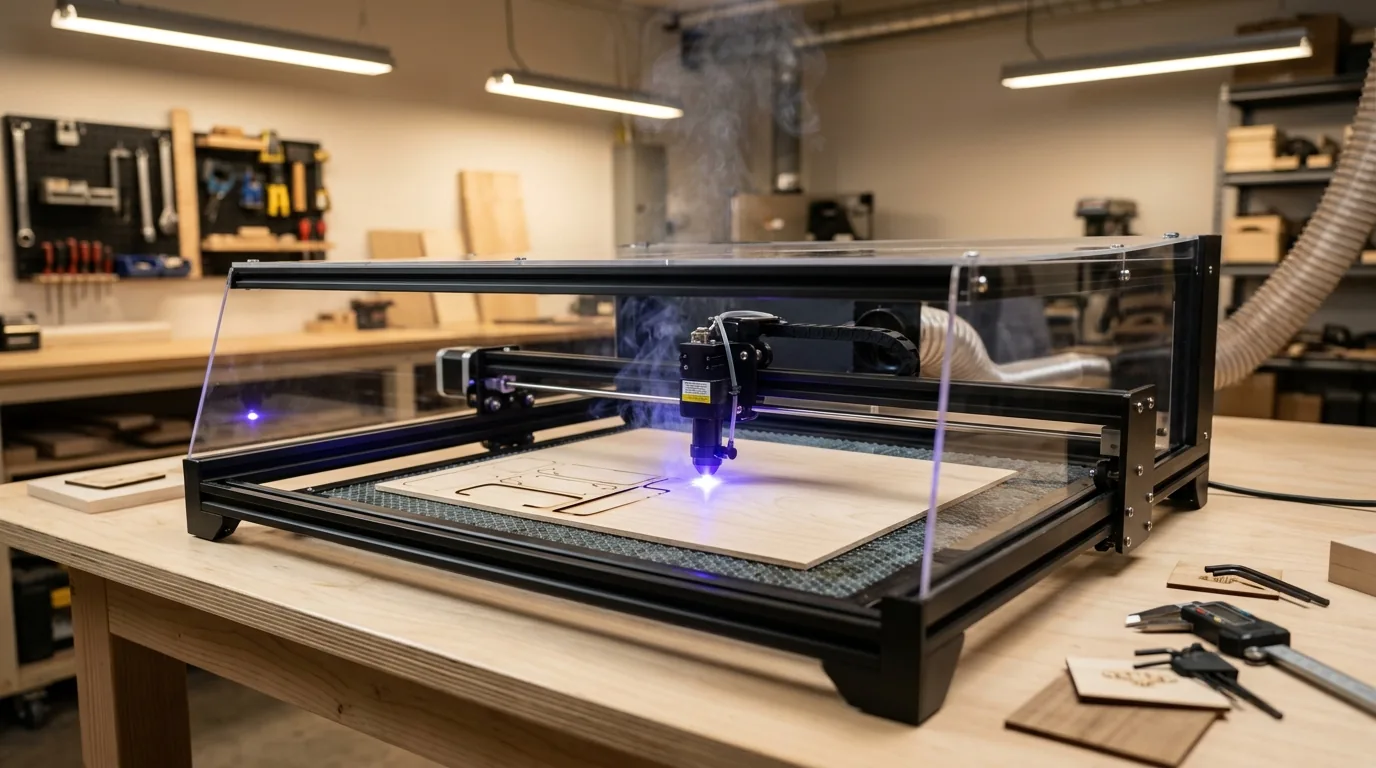
CO2 lasers (40-80W) cut 3mm basswood fastest – typically 20-35mm/s in a single pass – making them the top choice for production volume and thicker material. Diode lasers (20-40W) run slightly slower at 10-20mm/s but deliver tighter kerf precision and fit desktop budgets. Check the laser settings calculator to dial in your exact machine.
Both laser types excel with basswood. Choose CO2 if you prioritize speed and versatility with thicker materials; choose diode if budget, space, or portability matter most. For Etsy sellers and batch cutters running 3mm basswood, a 40W CO2 offers the best throughput per dollar once volume justifies the investment.
Why Isn’t Your Laser Cutting Through Basswood Cleanly?
Most incomplete cuts and excessive charring on basswood trace back to these four issues:
- Focus is off: Even a 1mm focus drift causes ragged edges or incomplete cuts – re-measure with your focus card or ruler tool before every session and confirm z-axis height matches your material thickness.
- Air assist not running: Without active airflow, smoke and char re-deposit in the kerf as the laser cuts, blocking the beam. Check that your pump is connected, the nozzle is positioned 2-3mm above the material, and airflow is confirmed before starting. Learning to prevent charring when laser cutting starts here.
- Inconsistent material: Craft-store plywood has glue pockets and variable density. Laser-grade basswood eliminates this variable – consistent wood means consistent single-pass cuts without mid-batch re-tuning.
- Dirty lens: Dust and resin residue reduce beam focus and power delivery by 10-20%. Clean your lens after every cutting session using a cotton swab with 99% isopropyl alcohol, wiping gently in one direction to avoid scratching the coating.
Where to Buy Premium Basswood Sheets for Laser Cutting
Crafteker 3mm basswood sheets are laser-grade, void-free, 12×12 inch, and pre-sanded – ready to load straight into your machine. The 12-pack at $24.99 ($2.08 per sheet) is the best value for production runs, locking in consistent color and density across your entire batch.
Production runs benefit most from the 12-pack – uniform density means the basswood laser cutting settings in this guide work reliably without re-tuning every job. Smaller packs suit one-off projects or first-time buyers testing the material.
Ready to cut? Get the wood that works with these settings:
→ Buy Crafteker 12-Pack Basswood Sheets on Amazon – $24.99
Clip the 7% coupon on the listing page – buy 2 packs and save 20% automatically.
Also available: 5-pack ($15.97) · 3-pack ($12.99)Frequently Asked Questions
What are the best laser settings for 3mm basswood?
Settings vary by machine wattage and type. Use the free Crafteker laser settings calculator at crafteker.com/laser-settings-calculator/ to get exact speed and power for your specific laser. As a general rule, start at 50-60% power and 20-30 mm/s for CO2 lasers, or 80-100% power at 15-25 mm/s for diode lasers – then test on scrap to dial in your focus and find the sweet spot for clean edges.
Is basswood or poplar better for laser cutting?
Basswood wins for quality and consistency. Basswood has lower resin content, finer grain, and more uniform density than poplar, which means cleaner kerf edges, better engraving contrast, and reliable repeatability across cuts. Poplar is best if you’re learning and want to minimize material cost – it’s cheaper but shows more variation in density and can produce inconsistent results.
What is the best wood for laser cutting and engraving?
3mm laser-grade basswood delivers clean edges, minimal charring, excellent engraving contrast, and void-free quality that justifies the cost for products you intend to sell. Crafteker basswood at $2.08 per sheet (12-pack) is production-ready and requires minimal finishing compared to alternatives.
Can I cut 3mm basswood in one pass?
Yes – on most CO2 and modern diode lasers at medium-to-high power settings. A 40W CO2 laser typically cuts 3mm basswood cleanly in a single pass at 25-30 mm/s and 60% power. A 40W diode laser will cut in one pass at 20-25 mm/s and 85-95% power. Always verify focus and run a test cut first – your machine’s age, lens condition, and air assist setup affect the final result.
Where can I buy basswood sheets for laser cutting?
Crafteker on Amazon offers three pack sizes: 3-pack $12.99, 5-pack $15.97, and 12-pack $24.99 ($2.08 per sheet – the best value for production runs). All sheets are 3mm thick, 12×12 inch, laser-grade, and void-free. Clip the 7% coupon available on the listing page to save even more.
About the author: Mike Dolan is a laser maker and wood materials specialist with 8+ years cutting basswood, birch, and MDF on diode and CO₂ machines. He tests every Crafteker basswood batch before listing.
- Verify
I switched from poplar to Crafteker basswood six months ago and immediately noticed the difference – every cut is clean on the first try, and the engraving contrast is so much better that my customers actually comment on the quality. The 12-pack at $2.08 per sheet is what finally convinced me it’s worth standardizing on basswood instead of chasing cheap material that wastes half my time adjusting settings.