

4 Living Hinge Patterns for 3mm Basswood (2026)
A living hinge in 3mm basswood can work, but only with a suitable slot pattern and honest expectations about cracking and limited repeat use. This guide compares four patterns, explains what controls flex, shows a five-step test method, and covers common failures.
By Mike Dolan ·
Quick Answer: Choose the least aggressive of 4 patterns that makes the curve, then test it on the same sheet before committing to the finished panel.
| Material | Engraving Contrast | Cut Ease | Smoke / Odor | Cost | Beginner Score |
|---|---|---|---|---|---|
| Basswood (3 mm) | ★★★★★ | Excellent — 1 pass | Low | $ | ★★★★★ |
| Baltic Birch Plywood | ★★★★ | Good — 2–3 passes | Medium | $$ | ★★★★ |
| MDF | ★★★ | Good — 1–2 passes | High (formaldehyde) | $ | ★★ |
| Pine / Soft Plywood | ★★★ | Poor — resin deposits | Medium-High | $ | ★★ |
Why Even Basswood Suits Living Hinge Tests
Even, fine-grained, consistent 3mm basswood tends to give more predictable bends and repeatable test strips than rough or inconsistent stock. Crafteker laser-grade, void-free sheets cost $2.08 per sheet in the 12-pack at $24.99, with a 5-pack at $15.97 and a 3-pack at $12.99, so breaking test strips is relatively cheap.
- Even, fine grain – bends and cracks are more predictable than in coarse or knotty stock
- Consistent 3mm thickness – test strips behave like your final panel
- Low resin – clean slot edges with less scorch, which helps the bridges stay sound
- Void-free layers – fewer hidden weak spots inside the flex zone
- Affordable sheets – at $2.08 a sheet, breaking test strips costs almost nothing
How a 3mm Basswood Living Hinge Works
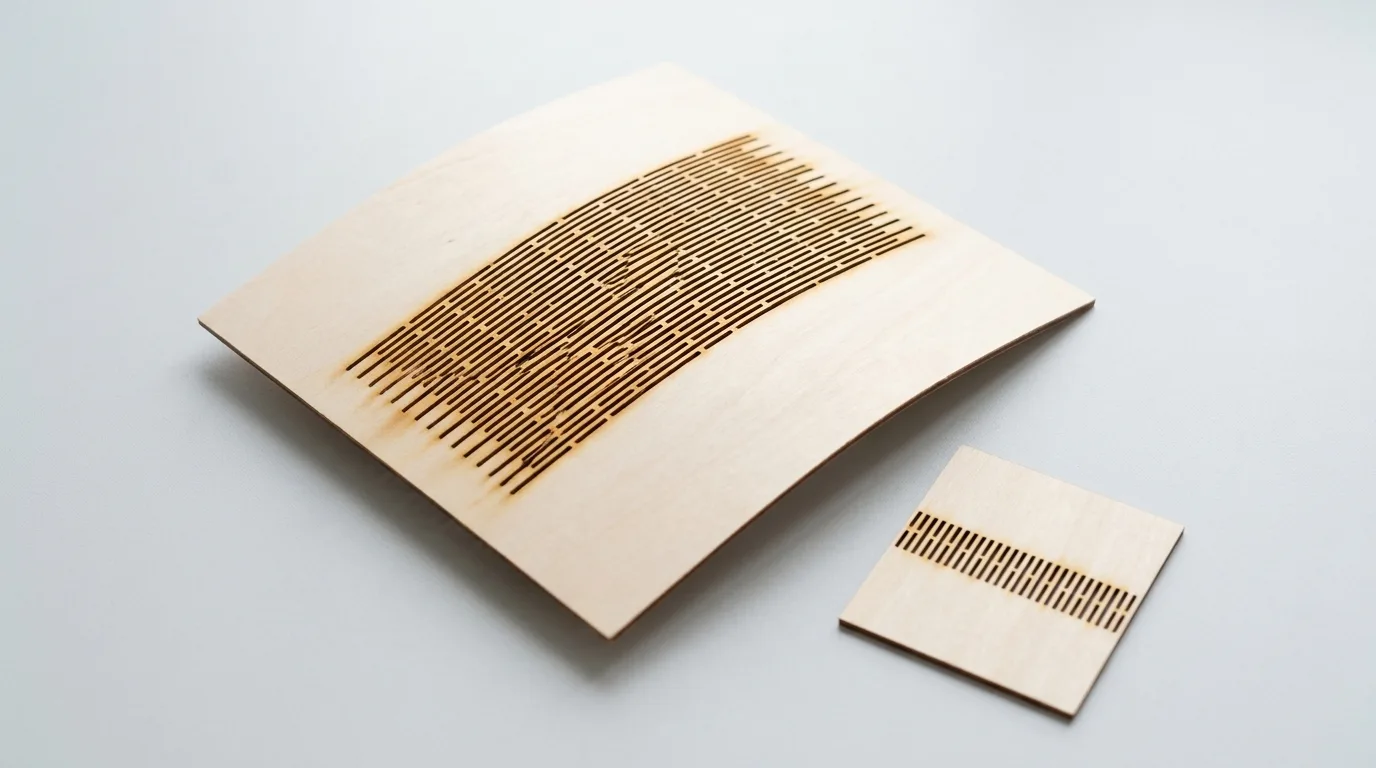
A 3mm basswood living hinge works by using relief cuts to remove material while leaving small bridges that share bending across a flex zone. Straight parallel slots and staggered slot rows are common patterns, but real wood is far less forgiving than acrylic, MDF, or purpose-made flexible plywood.
A 3mm basswood hinge may crack during the first bend, especially when the curve is tight, the bridges are weak, or scorch damage has hardened the cut edges. I once bent a test strip too quickly and watched a crack run from a slot end through a bridge, which was a useful reminder that wood does not negotiate.
Treat this feature as a bend-once-and-glue aid or a gentle curve aid, not as a guaranteed repeated-use lid hinge. A 3-ply plywood living hinge can be even less predictable because face veneers, a cross-oriented core, glue lines, voids, and defects respond differently under stress.
4 Living Hinge Patterns for 3mm Basswood
These four living hinge patterns offer different ways to spread bending through 3mm basswood, but every pattern needs a test strip before it reaches the finished panel.
- Straight parallel slots use repeated straight cuts across the flex zone, leaving bridges between slot ends. They suit simple bends and easy-to-edit test strips, but slot ends can concentrate stress, while narrow bridges can crack in 3mm wood.
- Offset-staggered rows alternate slot rows in a brick-like pattern. They spread bending across the zone and can produce a more even flex, but the many small bridges remain vulnerable to grain tear-out, veneer defects, and glue-layer failure.
- Lattice or grid patterns use intersecting or related cuts to create a network of flexible sections. They suit a broad flex zone, but removing too much material can leave weak islands and fragile bridges, especially in 3mm plywood.
- Wave or serpentine paths create a longer route for flexing through repeating curves. They suit decorative work or a gradual flex transition, but tight local turns can concentrate stress, so test the pattern on the actual sheet. Spiral patterns are specialized and generally not recommended for repeated opening and closing in ordinary 3mm plywood.

What Controls How Much a Living Hinge Flexes
Living hinge flexibility depends on the pattern, remaining wood, grain, cut quality, and the curve you ask the sheet to make. There is no universal slot, bridge, or bend-radius value for 3mm basswood or ordinary 3-ply plywood.
- Longer slots generally make the hinge more flexible and weaker.
- A smaller gap between slot ends leaves a narrower bridge, generally increasing flexibility while reducing strength.
- Closer row spacing creates a denser, more flexible zone, while wider spacing retains stiffness.
- More stagger or overlap spreads stress across the zone instead of creating a straight line of weak bridges.
- More rows widen the flex zone and distribute bending, but they also remove more material.
- Wider bridges improve strength and reduce flexibility, while narrower bridges do the opposite.
- Grain direction matters, but sources disagree on one universal rule for slot direction versus face grain. Test both practical orientations, and see the grain direction guide for how grain affects strength.
- Laser kerf changes slot openings and bridge dimensions, so measure the material and characterize the machine rather than trusting a downloaded file. Use this laser kerf compensation guide for the measuring process.
A wider, gradual bend is generally kinder to wood than a tight bend, but no universal safe bend radius applies here. Scorch, moisture, glue lines, voids, and sheet variation can all create local stiffness changes. Dampening or steaming is unproven for this use and may cause swelling, distortion, scorching, or delamination, so it is not a reliable fix.
A Living Hinge Test Strip Method
A test strip method lets you compare nearby patterns on the real sheet before committing a finished panel. Bend gently, support the panel, and avoid forcing the strip rapidly into shape. If you want a repeatable way to compare cut results, the test card playbook covers the habit.
- Cut matching strips: Cut small test strips from the same 3mm basswood or 3-ply sheet intended for the project, using the same material orientation, focus, lens, cut strategy, and machine settings.
- Measure the stock: Measure the actual sheet thickness and determine the laser kerf with a simple scrap test instead of assuming nominal stock or a published setting is exact.
- Vary one factor: Create nearby pattern variants that change one factor at a time, such as slot length, bridge width, row spacing, stagger, or number of rows.
- Bend and record: Bend each strip gradually by hand in both relevant grain orientations and record smooth flexing, cracks, delamination, or uneven stiffness.
- Choose conservatively: Choose the least aggressive pattern that achieves the required curve, then test the complete design before cutting the finished panel.
4 Common Living Hinge Problems
These four problems usually point to too much stress for the remaining wood, an unsuitable sheet, or a pattern that needs a gentler starting point.
- Snaps on the first bend. Cause: Bridges are too narrow, slots are too long or dense, or the curve is too tight. Fix: Use a less aggressive pattern, leave more material, widen the bend, and test scrap strips.
- Cracks start at slot ends. Cause: Sharp ends create stress concentrations. Fix: Use rounded slot ends where practical and avoid abrupt transitions.
- Delaminates or splits. Cause: Cross-grain plies, glue layers, voids, veneer defects, and excess bending stress fail differently from solid basswood. Fix: Use sound stock, inspect the cut zone, and bend gradually rather than treating ordinary 3-ply like flexible plywood.
- Fails after repeated opening. Cause: Wood bridges fatigue, crush, or crack under repeated flexing. Fix: Use the hinge for a bend-once-and-glue assembly or replace it with hardware or purpose-made flexible plywood.
When to Skip a Living Hinge
Skip a living hinge when the joint must open and close reliably, carry load, survive rough handling, or operate for a long time. A laser-cut flex zone is a clever construction aid, but it is not automatically a durable mechanical hinge.
Choose another approach if the bend is tight, the sheet has visible voids or weak veneers, the project cannot tolerate a failed panel, or the required direction has not passed a test strip. A small hardware hinge is the safer choice for dependable movement.
- Use a finger-joint box for a rigid corner or bend-and-glue construction.
- Use purpose-made flexible plywood when you need a wood flex zone designed for bending, and still test it first.
- Use a flat-pack design when shipping matters, as explained in this flat-pack shipping guide, but remember that a shipping-friendly flex feature is not automatically a durable mechanical hinge.
Where to Get Basswood for Living Hinge Tests
Crafteker 3mm basswood sheets are 12×12 inch, laser-grade, void-free, and pre-sanded – consistent thickness means your test strips behave like your final panel. At $24.99 for 12 sheets ($2.08/sheet), breaking a few strips while you tune a pattern costs almost nothing.
Ready to test your first living hinge?
→ Buy Crafteker 12-Pack Basswood Sheets on Amazon – $24.99
Also available: 5-pack ($15.97) · 3-pack ($12.99)
Frequently Asked Questions
Can 3mm basswood make a living hinge?
Yes, a laser-cut living hinge can work in 3mm basswood for a gentle curve or bend-once-and-glue assembly. It is less forgiving than acrylic, MDF, or purpose-made flexible plywood and may crack on the first bend.
Does grain direction matter for a wooden living hinge?
Yes, grain direction affects stiffness and crack behavior, but sources disagree on a universal slot-direction rule. Test both practical orientations on strips from the actual sheet and choose the one that bends most evenly.
What makes a living hinge more flexible?
Longer slots, narrower bridges, smaller gaps between slot ends, closer rows, more rows, and denser or more staggered patterns generally increase flexibility while reducing remaining strength. Kerf and sheet construction also change the result.
Why did my 3-ply plywood living hinge delaminate?
Cross-oriented plies, glue lines, voids, veneer defects, scorch, and excessive bending stress can separate or split. Inspect the stock, bend gradually, and do not assume ordinary 3-ply behaves like purpose-made flexible plywood.
Can a wooden living hinge handle repeated opening and closing?
Do not assume it can. Ordinary 3mm basswood and 3-ply plywood bridges can fatigue, crush, or crack, so use a hardware hinge or purpose-made flexible plywood for repeated movement.
About the author: Mike Dolan is a laser maker and wood materials specialist with 8+ years cutting basswood, birch, and MDF on diode and CO₂ machines. He tests every Crafteker basswood batch before listing.
I would start with a scrap strip from the exact sheet going into the project, not a downloaded pattern that worked for someone else. A slow hand bend tells me far more than a confident guess about grain, kerf, or bridge strength.