
Basswood vs Birch Plywood for Laser Cutting: Which is Better?
For laser cutting, basswood produces cleaner cuts with minimal char and no visible glue lines, while birch plywood is stronger and better suited for structural projects like boxes and puzzles. Neither is universally better — the right choice depends entirely on your project type. This guide compares both materials across cut quality, char, strength, price, and best use cases so you can choose the right wood for every job.
By Mike Dolan — laser materials specialist, updated

| Material | Engraving Contrast | Cut Ease | Smoke / Odor | Cost | Beginner Score |
|---|---|---|---|---|---|
| Basswood (3 mm) | ★★★★★ | Excellent — 1 pass CO₂, 2–3 diode | Low | $ | ★★★★★ |
| Baltic Birch Plywood | ★★★★ | Good — 2 passes needed | Medium | $$ | ★★★★ |
| MDF | ★★★ | Good — 1 pass | High (formaldehyde) | $ | ★★ |
| Cherry / Walnut | ★★★★★ | Moderate — 2–3 passes | Low | $$$ | ★★★ |
What Is the Main Difference Between Basswood and Birch Plywood?
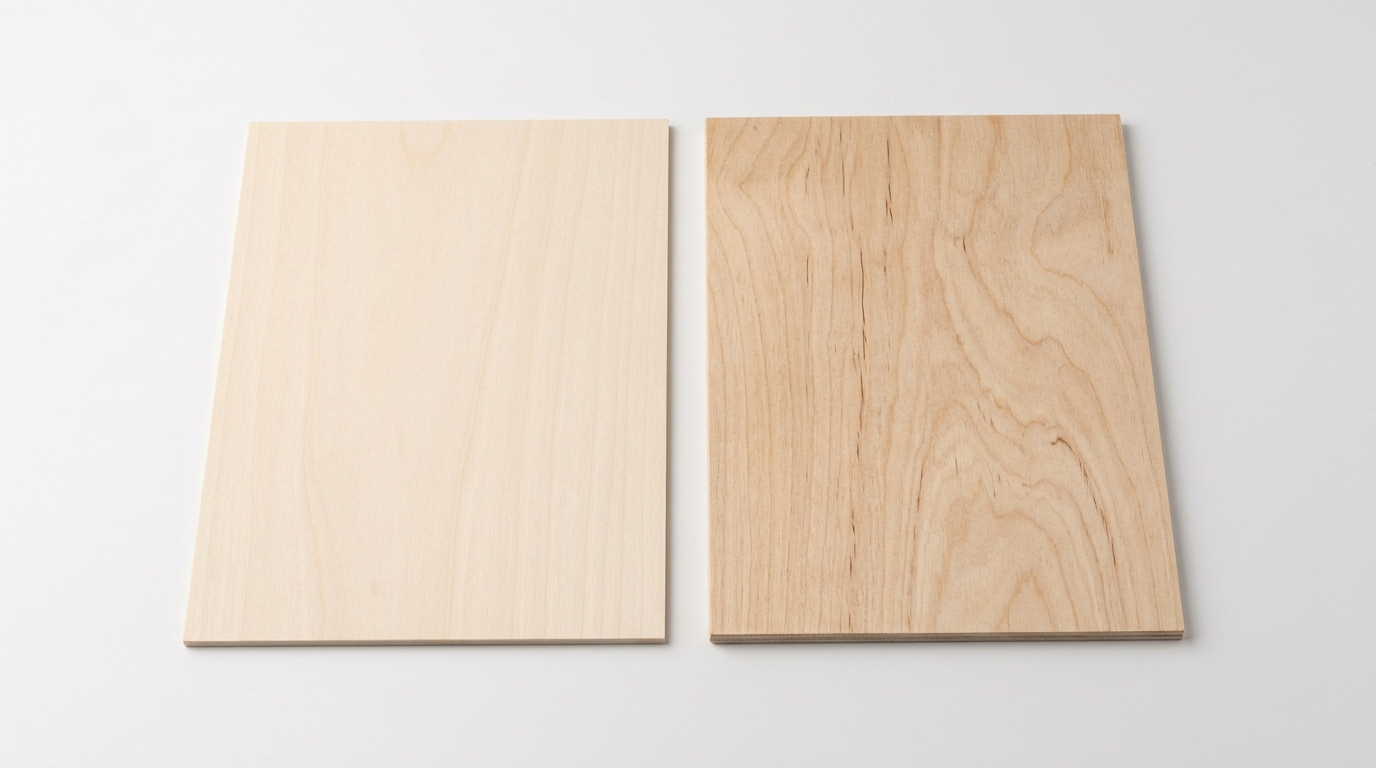
Basswood is a solid wood — a single species (Tilia americana) cut and dried into flat sheets. It has uniform grain, low resin content, and no internal glue layers. Birch plywood is an engineered wood — thin veneers of birch bonded together in alternating grain directions with adhesive.
This structural difference drives every other comparison:
- Basswood: no glue layers → cleaner laser cuts, less char, better edge finish
- Birch plywood: cross-ply construction → stronger, more warp-resistant, better for structural parts
For laser cutting specifically, the glue layers in birch plywood are the critical variable. Standard adhesives char heavily under a laser beam, producing dark lines on every cut edge. Laser-grade Baltic birch minimizes this, but it still shows. Basswood has no adhesive layers to burn.
Basswood vs Birch Plywood: Full Comparison Table
| Property | Basswood (3mm solid) | Baltic Birch Plywood (3mm) |
|---|---|---|
| Char level | ⭐ Minimal | ⚠️ Low–medium (glue lines) |
| Glue lines on cut edge | ✅ None | ❌ Visible (dark bands) |
| Single-pass cut (CO₂ 40W) | ✅ Yes | ✅ Yes |
| Single-pass cut (diode 10W) | ✅ Yes | ⚠️ Usually 2 passes |
| Structural strength | ⚠️ Moderate | ⭐ High (cross-ply) |
| Warp resistance | ⚠️ Moderate | ⭐ High |
| Surface finish | ⭐ Smooth, light color | ⚠️ Good, slightly darker |
| Engraving quality | ⭐ Excellent, fine detail | ⚠️ Good, grain shows more |
| Best for | Ornaments, jewelry, signs, fine detail | Boxes, puzzles, structural parts |
| Price per 12×12″ sheet | $2.25 (Crafteker 12-pack) | $1.50–$3.00 |
When Should You Use Basswood vs Birch for Laser Projects?
Choose basswood when:
- Edge finish matters — jewelry, ornaments, keychains sold on Etsy
- Fine engraving detail — the uniform grain holds crisp lines better
- Natural wood color is important — basswood is lighter and more consistent
- You want clean results with minimal sanding or finishing
- Cutting on a diode laser (less power to burn through glue layers)
Choose birch plywood when:
- Structural strength matters — boxes, organizers, shelf brackets
- Larger flat pieces that need to stay flat over time
- Parts that will be painted or stained (hiding glue lines doesn’t matter)
- Budget is the primary concern for high-volume production
- Puzzle pieces that need durability through repeated handling
How Do Laser Settings Differ Between Basswood and Birch Plywood?
Basswood requires less laser power than birch plywood because it has lower density and no adhesive layers to burn through. Using birch settings on basswood will result in over-cutting and excessive char. Always test on a scrap piece when switching between materials.
| Machine | Material | Speed | Power | Passes |
|---|---|---|---|---|
| xTool S1 40W | 3mm Basswood | 12 mm/s | 95% | 2 |
| xTool S1 40W | 3mm Birch 3-ply | 10 mm/s | 100% | 2–3 |
| Glowforge Pro 45W | 3mm Basswood | 22 mm/s | 80% | 1 |
| Glowforge Pro 45W | 3mm Birch 3-ply | 18 mm/s | 90% | 1–2 |
| Sculpfun S30 Pro Max 40W | 3mm Basswood | 9 mm/s | 100% | 3 |
| Sculpfun S30 Pro Max 40W | 3mm Birch 3-ply | 7 mm/s | 100% | 3–4 |
Which Wood Do Etsy Laser Sellers Actually Use?
Among Etsy sellers who run laser cutting as a business, the material split is roughly:
- Ornaments, earrings, keychains: 80%+ use basswood — clean edges require no post-processing before selling
- Boxes, organizers, shelves: 70%+ use Baltic birch — strength matters more than edge appearance
- Signs and name plaques: split 50/50 — both work, basswood gives lighter color
- Puzzle pieces: 80%+ use Baltic birch — durability under repeated handling
The key insight: if your customer sees the edges, use basswood. If the edges are hidden or painted, birch is fine. Most high-volume Etsy laser sellers stock both and choose by project type.
According to a USDA Forest Products Laboratory study on wood adhesive performance, urea formaldehyde resins — the standard adhesive in most plywood — produce significantly more carbonization under localized heat than solid wood of equivalent density. This is why birch plywood edges char more visibly than basswood at equivalent laser settings.
Ready to start cutting? Get the wood that works:
→ Buy Crafteker 12-Pack Basswood Sheets on Amazon – $24.99
Clip the 7% coupon on the listing page – buy 2 packs and save 20% automatically.
Also available: 5-pack ($15.97) · 3-pack ($12.99)
Frequently Asked Questions: Basswood vs Birch for Laser Cutting
Is basswood or birch better for laser cutting ornaments?
Basswood is better for ornaments. It produces minimal char and has no visible glue lines on edges — giving a clean finish without sanding. Birch shows dark glue lines at each ply boundary that require sanding or painting to hide.
Which is stronger — basswood or birch plywood?
Birch plywood is stronger. Its cross-ply construction resists splitting and warping, making it better for structural projects like boxes and puzzle frames. Basswood is strong enough for ornaments and small assembled pieces but not for load-bearing applications.
Why does birch plywood show dark lines when laser cut?
Those are the glue layers between plies. Standard adhesive chars heavily under a laser beam, producing dark bands on the cut edge. Laser-grade Baltic birch reduces this effect but does not eliminate it.
Can I use birch plywood settings for basswood?
No — basswood needs less power than birch. Reduce power by 10–15% or increase speed by 15–20% compared to your birch settings. Always test on a scrap piece first.
Which wood is cheaper for laser cutting?
Baltic birch typically runs $1.50–$3.00 per sheet. Laser-grade basswood like Crafteker is $2.08/sheet in 12-pack pricing — comparable to quality birch, with better results for fine detail work.
Related Guides
- Basswood Sheets 1/8 Inch: Everything You Need to Know
- Basswood Laser Cutting Settings: The Complete 3mm Guide
- How to Prevent Charring When Laser Cutting Wood: 7 Proven Methods
- Best Laser Cut Wood Items to Sell on Etsy in 2026
Bottom Line: Basswood or Birch for Your Laser Projects
- Ornaments, jewelry, keychains, fine detail → Basswood. Clean edges, no glue lines, less sanding.
- Boxes, puzzles, structural parts → Baltic birch. Stronger, more warp-resistant.
- Signs, painted pieces → Either works. Birch if budget-sensitive, basswood for better natural color.
Try Crafteker Basswood for Your Next Project
Void-free, 8–12% moisture, ±0.2mm tolerance. Clean cuts on any laser machine.
→ 3-Pack ($12.99) — try it first |
→ 12-Pack ($24.99) — best value
Great breakdown. I’ve been using Baltic birch for everything but kept getting those dark edge lines on my ornaments. Switched to basswood for display pieces and the difference is night and day — no sanding needed before painting. Using birch only for boxes now.