Balsa Wood vs Basswood for Laser Cutting: Which One Wins?
By Mike Dolan · Laser maker & wood materials specialist ·
Basswood wins every time for laser cutting. Despite balsa being lighter and cheaper, its open grain structure produces fuzzy, torn edges under a laser beam — while 3mm basswood delivers clean cuts, smooth engravings, and strong finished pieces. If you searched for “balsa wood laser cutting” hoping balsa would work, this guide will show you exactly why basswood is the upgrade worth making — and how much it actually costs.
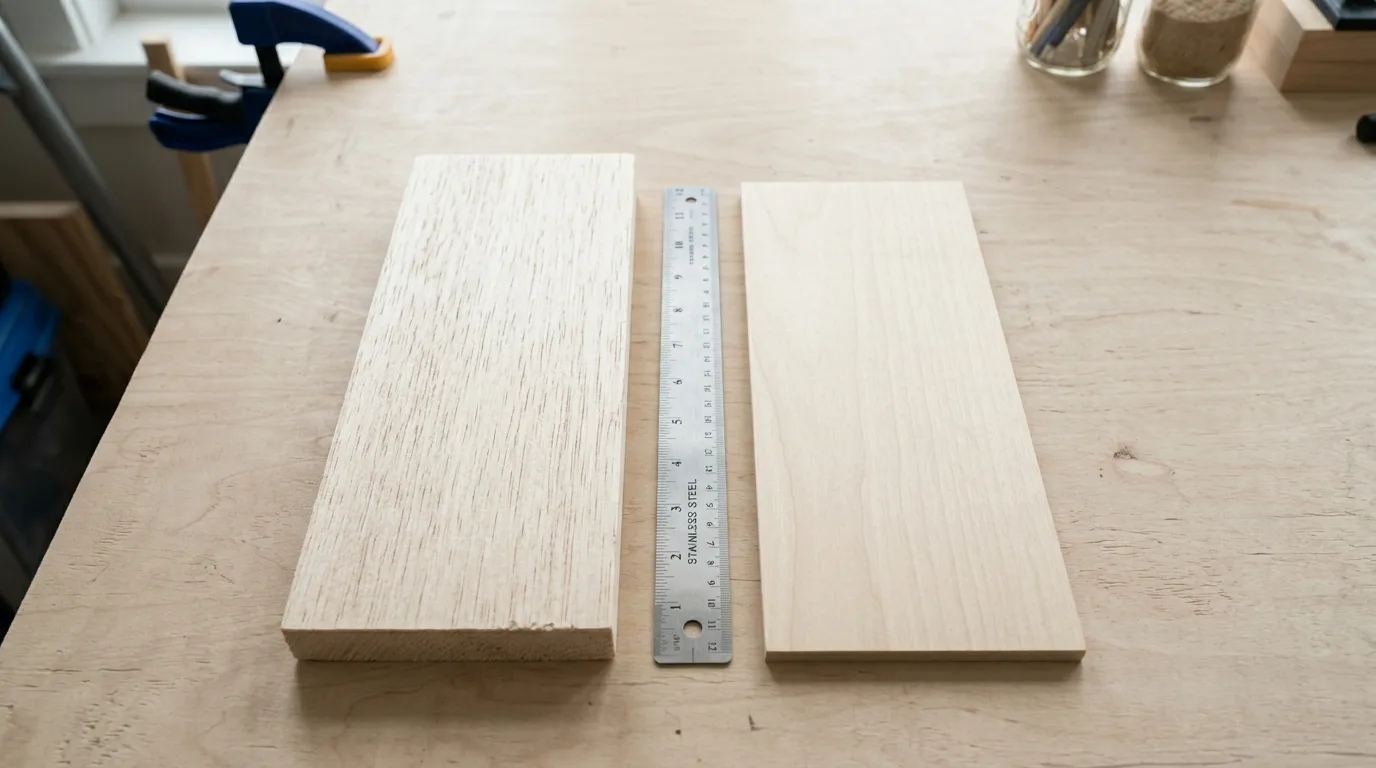
Left: balsa plank with visible open grain. Right: Crafteker 3mm basswood with fine, uniform grain — the difference in cut quality is dramatic.
| Material | Engraving Contrast | Cut Ease | Smoke / Odor | Cost | Beginner Score |
|---|---|---|---|---|---|
| Basswood (3 mm) | ★★★★★ | Excellent — 1 pass CO₂, 2–3 diode | Low | $ | ★★★★★ |
| Baltic Birch Plywood | ★★★★ | Good — 2 passes needed | Medium | $$ | ★★★★ |
| MDF | ★★★ | Good — 1 pass | High (formaldehyde) | $ | ★★ |
| Cherry / Walnut | ★★★★★ | Moderate — 2–3 passes | Low | $$$ | ★★★ |
What Is the Actual Difference Between Balsa and Basswood?
Balsa (Ochroma pyramidale) is the world’s lightest commercial wood, with a density of just 6–12 lb/ft³. Its cells are large and air-filled — that’s what makes it perfect for model aircraft, life preservers, and surfboard cores. Those same large open cells, however, make it a poor laser cutting material: the beam tears fibers rather than vaporizing them cleanly.
Basswood (Tilia americana) has a density of 20–28 lb/ft³ and a fine, uniform grain with virtually no resin pockets. According to the USDA Forest Products Laboratory, basswood has one of the most consistent wood structures of any North American hardwood — which is exactly what a laser needs to produce repeatable results.
Balsa vs Basswood for Laser Cutting: Full Comparison
| Property | Balsa | Basswood (Crafteker 3mm) |
|---|---|---|
| Density | 6–12 lb/ft³ | 20–28 lb/ft³ |
| Cut edge quality | Fuzzy, fiber tear-out | Clean, smooth |
| Moisture stability | Inconsistent (absorbs humidity) | 8–12% kiln-dried, consistent |
| Engraving detail | Poor (grain tears) | Excellent (fine uniform grain) |
| Structural strength | Very low — snaps easily | Good — holds ornament hooks, slots |
| Available as plywood | Rarely, no triple-layer | ✅ Triple-layer (basswood + poplar core) |
| Void risk | High (soft core layers) | Zero — solid poplar core |
| Price per 12×12 sheet | $1–3 (hobby grades) | $2.25 (Crafteker 12-pack) |
| Best for laser crafts | ❌ Not recommended | ✅ Industry standard |
Why Does Balsa Cut So Poorly Under a Laser?
Three physical properties make balsa a bad laser material:
- Open cell structure — balsa’s cells are 5–10× larger than basswood’s. The laser beam hits air pockets between fibers and scatters energy unpredictably, leaving ragged, hairy edges instead of clean cuts.
- Variable moisture content — balsa absorbs and releases humidity rapidly. At >15% moisture, the laser wastes energy turning water to steam instead of cutting wood. Settings that work Monday may fail Thursday after rain.
- No structural core — solid balsa has no cross-grain layers to resist splitting. Laser-cut balsa pieces often crack along the grain when you try to assemble or hang them.
Kiln-dried 3mm basswood solves all three problems: fine grain for clean cuts, controlled 8–12% moisture for consistent settings, and a triple-layer plywood construction that resists splitting in any direction.

Clean cut edge on Crafteker 3mm basswood — no fuzzy fibers, no char bleed, crisp geometry on every pass.
What Are the Laser Settings for 3mm Basswood vs Balsa?
Because balsa’s moisture and density vary so much, there are no reliable universal settings — you have to run test cuts every session. Basswood is the opposite: kiln-dried to a consistent 8–12%, it gives repeatable results batch after batch.
| Machine | Material | Speed (mm/s) | Power | Passes |
|---|---|---|---|---|
| xTool D1 Pro 10W | 3mm Basswood | 5 | 100% | 3 |
| xTool D1 Pro 20W | 3mm Basswood | 8 | 100% | 2 |
| xTool S1 20W | 3mm Basswood | 10 | 100% | 1–2 |
| Glowforge Aura | 3mm Basswood | — | Full / 100% | 1 |
| xTool D1 Pro 10W | Balsa (4mm) | 8 | 80% | 2–4 (varies) |
For all xTool, Glowforge, Atomstack, and Sculpfun models, use the free Crafteker Laser Settings Calculator — it covers cut and engrave settings for 50+ machines on 3mm basswood.
Is Balsa Wood Ever the Right Choice for Laser Projects?
Yes — in one specific case. If your project requires extreme lightness (model aircraft ribs, RC plane frames, architectural scale models where structural integrity comes from the assembly, not the material), balsa’s low weight justifies its messy cut quality. In those cases, you’re usually sanding and painting anyway, so fuzzy edges don’t matter.
For everything else — ornaments, signs, keychains, bookmarks, name plaques, Etsy products, gift tags, coasters — basswood is the correct material. It cuts cleaner, engraves sharper, holds paint better, and won’t snap when you push a hook through it.
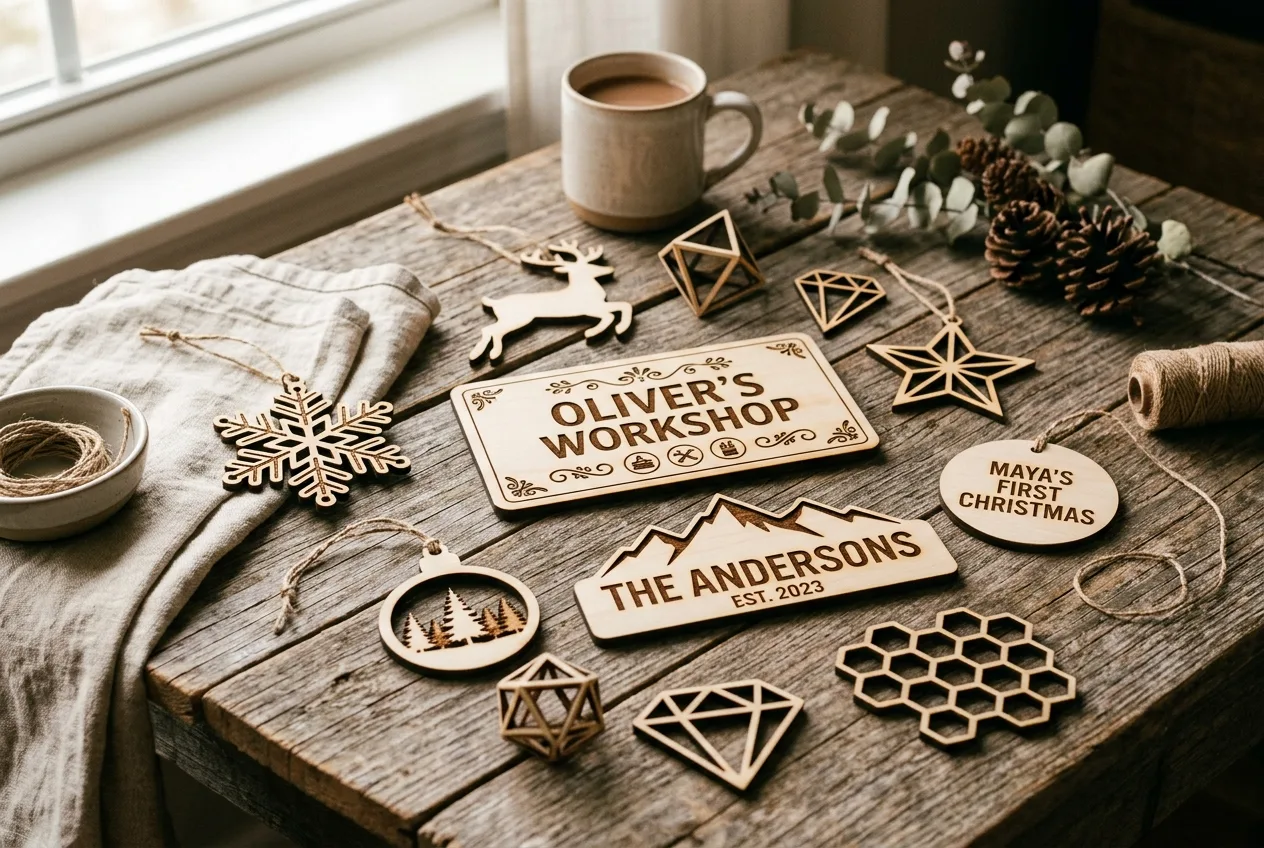
Laser-cut projects made from Crafteker 3mm basswood — Christmas ornaments, name plaques, and decorative signs with sharp engraving detail.
How Much Does Basswood Cost vs Balsa?
This surprises most buyers: premium kiln-dried basswood is often cheaper than comparable balsa sheets once you factor in consistent quality.
- Craft store balsa (hobby-grade, 12×12 in): $2–4/sheet, no moisture control, random grain quality
- Generic basswood plywood (Amazon): $2.50–4/sheet, unknown moisture, voids common
- Crafteker 3mm basswood (12-pack): $2.08/sheet — kiln-dried 8–12%, zero voids, ±0.2mm tolerance, FSC-certified
For Etsy sellers running 20+ sheets per week, the $2.08/sheet price point on the 12-pack makes Crafteker the most economical premium option. Use the Profit Optimizer to calculate your exact ROI per sheet based on your product prices and cut time.
The Bottom Line: Balsa Wood vs Basswood for Laser Cutting
If you need clean cuts, sharp engravings, and strong finished pieces — choose 3mm basswood, not balsa. Basswood’s fine grain, controlled moisture, and triple-layer plywood construction make it the laser cutting standard for hobbyists, Etsy sellers, and small craft businesses. Balsa is for model planes. Basswood is for everything else.
For more material comparisons and verified settings, see the Basswood Laser Cutting Settings Guide — the most complete resource for 3mm basswood on diode and CO2 lasers.
Ready to Switch to Basswood?
Crafteker 3mm basswood ships Prime-eligible on Amazon. At $2.08/sheet for the 12-pack, it’s the lowest cost-per-project for production laser cutting:
Shop Crafteker 3mm Basswood on Amazon →
Clip the 7% coupon on the listing page – buy 2 packs and save 20% automatically.
Frequently Asked Questions: Balsa vs Basswood Laser Cutting
Can you laser cut balsa wood?
Yes, balsa wood can be laser cut, but the results are poor. Balsa’s open, coarse grain causes fuzzy edges and fiber tear-out. It also burns unevenly due to inconsistent moisture content. For clean laser cuts, basswood is a far better choice.
Is balsa wood or basswood better for laser cutting?
Basswood is better for laser cutting in every category: cleaner cut edges, consistent moisture (8–12% kiln-dried), stronger finished pieces, and better engraving detail. Balsa is soft and light but produces fuzzy cuts and weak parts.
What is the difference between balsa and basswood?
Balsa (density 6–12 lb/ft³) is the world’s lightest commercial wood — used in model aircraft and floats. Basswood (density 20–28 lb/ft³) has fine, uniform grain and is the standard for laser-cut crafts, signs, and ornaments. Basswood holds detail; balsa does not.
What wood is best for laser cutting ornaments and Etsy crafts?
3mm basswood plywood is the industry standard for laser-cut ornaments, signs, keychains, and Etsy products. It cuts clean at low power, engraves with high contrast, and holds paint and stain evenly. Crafteker 3mm basswood at $2.08/sheet is optimized for production use.
Why does my balsa wood laser cut poorly?
Balsa cuts poorly because of its open, fibrous grain structure and inconsistent moisture content. The laser beam tears fibers instead of cleanly vaporizing them, leaving ragged edges. Switch to kiln-dried 3mm basswood (8–12% moisture) for clean, repeatable cuts.
About the Author
Mike Dolan is a laser maker and wood materials specialist with hands-on experience testing 50+ laser machines and wood species. He founded Crafteker to bring A+ grade FSC-certified basswood to the laser cutting community at production-friendly prices. All settings and material comparisons on this site are verified on real machines with real Crafteker sheets.
This is exactly what I needed! I wasted two sheets of balsa last week trying to cut ornaments on my xTool D1 Pro and the edges were terrible. Switching to basswood this week — does the 12-pack ship fast?