

Etsy 2026 Creativity Standards: Laser-Cut Wood Compliance
Etsy’s own Creativity Standards require laser-cut items to be based on your original design, with any AI use and production partners disclosed on the listing. This article walks through what’s official policy versus third-party interpretation, and gives you four concrete steps to document your original-design process so your shop stays compliant.
By Mike Dolan ·
Quick Answer: Etsy 2026 creativity standards laser-cut wood handmade compliance means laser, CNC, and Cricut items must use your original design, disclose AI use in the listing description, and disclose any production partner in shop settings.
| Material | Engraving Contrast | Cut Ease | Smoke / Odor | Cost | Beginner Score |
|---|---|---|---|---|---|
| Basswood (3 mm) | ★★★★★ | Excellent – 1 pass | Low | $ | ★★★★★ |
| Baltic Birch Plywood | ★★★★ | Good – 2-3 passes | Medium | $$ | ★★★★ |
| MDF | ★★★ | Good – 1-2 passes | High (formaldehyde) | $ | ★★ |
| Pine / Soft Plywood | ★★★ | Poor – resin deposits | Medium-High | $ | ★★ |
What Etsy’s 2026 Creativity Standards Actually Require for Laser-Cut Wood
Etsy’s Creativity Standards say it plainly: items made with computerized tools like a laser cutter, 3D printer, CNC machine, or Cricut have to be based on your own original design. That part isn’t up for debate – it’s straight from Etsy’s own policy pages.
Etsy’s “What Can I Sell on Etsy?” page backs this up too. It confirms items can be handmade, hand-altered, hand-assembled, or produced with tools like these, as long as the design underneath started with you.
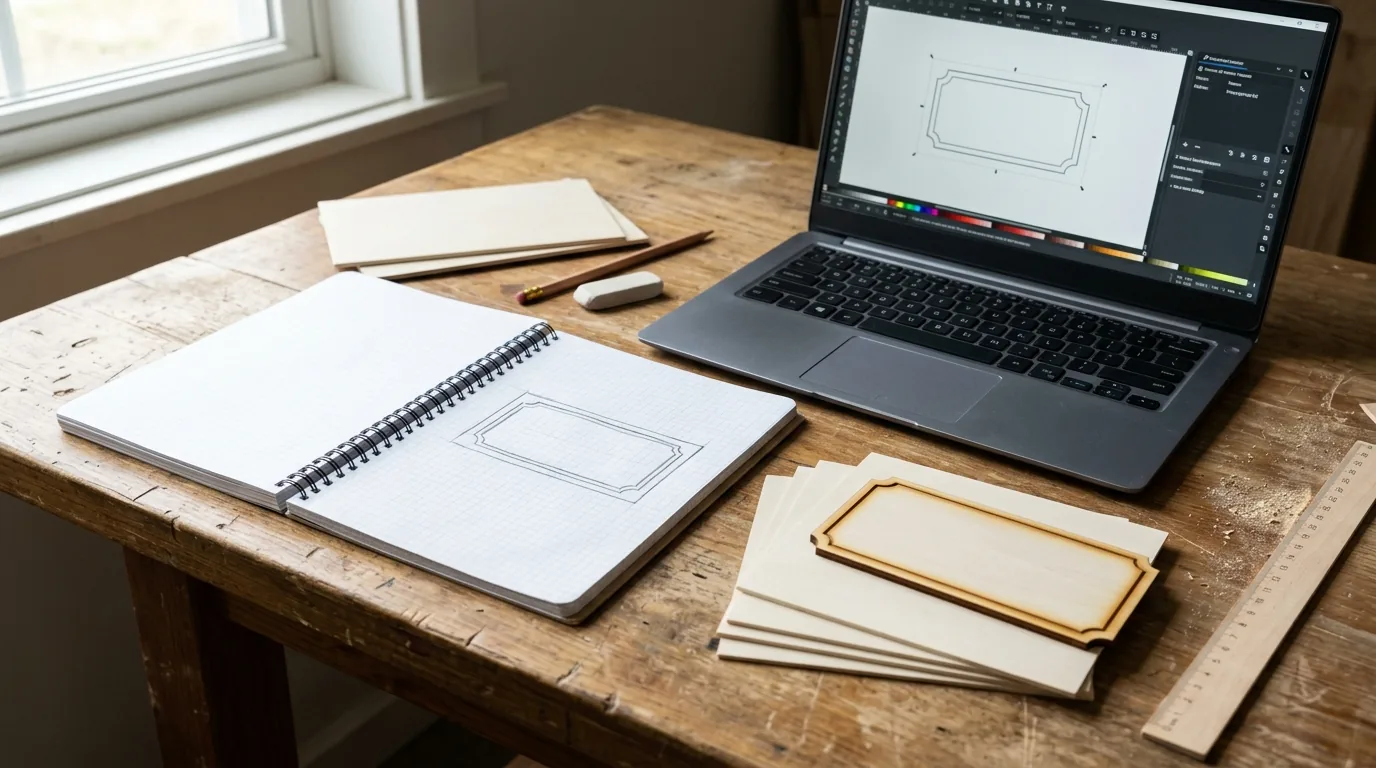
I still remember sketching a fox silhouette for a batch of basswood ornaments on graph paper, eraser marks and all, before I ever opened my cutting software. Light brown edges from the laser are normal – a paper trail proving the design is yours is the part that actually protects your shop.
That notebook habit stuck because basswood makes it worth the effort. Its dense, consistent grain, backed by USDA Forest Products Laboratory data, means you can hand-sand, re-carve, or tweak a laser-cut piece afterward without fighting soft spots or tear-out.
Turning a base shape into something substantially your own becomes a quick bench task instead of a redesign project. If you want the initial cut clean enough that hand-alteration doesn’t feel like extra work, start with dialed-in basswood laser cutting settings, then pick projects worth designing from scratch using a list like best laser cut items to sell on Etsy.
What Counts as an Original Design When You’re Using a Laser Cutter
Etsy’s own policy pages don’t spell out an exact modification threshold – there’s no official rule for how much of a purchased template you have to change. That gap is exactly why third-party seller compliance guides have stepped in with their own interpretation.
Several 2026 guides agree on one thing: running an unmodified purchased SVG or STL file, or stock clipart, straight through your laser probably doesn’t clear the original-design bar. The safer move these guides recommend is substantially transforming the template – resize the proportions, redraw the fine details, combine a few elements, add your own line work – until a buyer couldn’t trace it back to the original listing. Think transformation, not just recoloring the same file and calling it a new listing.
Some of these guides also report Etsy tightening enforcement around August 11, 2026 – flagged clearly as third-party reporting, not a date Etsy itself has confirmed anywhere in its Creativity Standards. Guides differ on specifics, but the common thread is: don’t wait for an enforcement date to find out your file wasn’t original enough.
I bought a $4 mandala SVG two years ago and ran it unchanged for a full year without a second thought. After reading a few of these guides, I spent one evening redrawing every third petal and adding my own border – just to be safe. Redrawing petals sounds tedious, but it took less time than I’d spent picking out font pairings for the listing title.
AI Disclosure and Production-Partner Disclosure: What’s Actually Required
Etsy requires two disclosures, and both are confirmed official policy, not guesswork. Any AI use in your design process has to show up in the listing description itself – tags alone don’t count. And if an outside shop or fabricator helps physically produce your item, that production partner has to be disclosed in your shop settings and on the relevant listings. That’s the shop’s Production Partners page under settings, plus a mention wherever a partner-made piece shows up in your listings.
If you’re not sure whether your process counts, ask yourself: did a tool generate part of the design, or just help you cut it? The first needs disclosure. The second is just… using a laser cutter.
Example wording only, not Etsy’s mandated text: “Design created with AI assistance and finished by hand,” or “Engraving completed by [Shop Name], our production partner.” Use whatever phrasing fits your own process, as long as it’s plain and upfront. Neither disclosure has to read like a confession – buyers mostly just want to know what they’re getting, and plain language does that fine.
I scrolled past the AI-disclosure toggle for months, figuring it only applied to AI-generated images. Then it hit me: the AI-assisted lettering generator I’d been using for custom name signs counted too. Took one line added to my listing description that afternoon to fix it.

4 Practical Steps to Document Your Original Design Process
Four habits cover it: save your drafts, disclose AI plainly, list your production partners, and audit what’s already live in your shop.
- Save every sketch, vector file, and CAD revision per design. It’s your proof the piece started as your own work, not an unmodified template.
- Write a plain AI disclosure line whenever AI materially shaped a design – you can still do your own prompting and editing.
- List any outside cutting or engraving shop as a production partner in Etsy’s shop settings and the relevant listings.
- Audit older listings for unmodified marketplace SVG or STL files, add AI disclosure where it’s missing, and keep dated screenshots of your files.
One seller keeps a folder per product line – first pencil sketch, three vector revisions, a dated screenshot of the final laser file. She calls it her “just in case Etsy asks” folder.
3 Mistakes Laser-Cut Sellers Make With Etsy’s Creativity Standards
The three mistakes that trip up sellers most all come from misunderstanding what “original” actually covers.
- Assuming the laser makes it original. Cutting an unmodified purchased template on your own machine doesn’t change who designed it.
- Hiding AI use instead of disclosing it, out of fear it’ll scare off buyers – that’s the exact gap compliance guides flag as risky.
- Skipping production-partner disclosure, assuming the rule only applies to non-laser goods when an outside shop does the actual cutting.
I told myself for a year that cutting a $6 template on my own machine made it “handmade enough.” A compliance guide set me straight – it’s the design, not the button you press, that matters.
Why Crafteker Basswood Makes Genuine Hand-Alteration Easy
Crafteker basswood sands, paints, and re-carves cleanly because the surface is void-free and consistent – no soft spots to fight when you’re turning a laser-cut base shape into something actually your own. Sheets run $12.99 for a 3-pack, $15.97 for a 5-pack, and $24.99 for a 12-pack, about $2.08 a sheet at the best-value size.
I switched from a bargain plywood 12-pack to Crafteker’s after a soft spot tore mid-carve on a template-based ornament I was hand-altering. For picking what to design from scratch, best laser cut items to sell on Etsy is a solid companion read.
Ready to cut? Get the wood that works with these settings:
→ Buy Crafteker 12-Pack Basswood Sheets on Amazon – $24.99
Also available: 5-pack ($15.97) · 3-pack ($12.99)
Frequently Asked Questions
Does Etsy require laser-cut items to be an original design?
Yes. Etsy’s own Creativity Standards state that items produced with computerized tools like laser cutters, 3D printers, CNC machines or Cricut machines must be based on the seller’s original design – this is confirmed, official policy, not a guideline you can shrug off.
Can I use a purchased SVG file for laser cutting and sell it on Etsy?
Technically Etsy’s own pages don’t spell out an exact modification threshold. But compliance guides treat an unmodified purchased SVG or STL as risky, and I’ve watched sellers learn that the hard way. Redraw it, resize it, add your own line work – make it yours before it hits the bed.
Do I have to disclose if I used AI to design a laser-cut product?
Yes. Etsy’s Creativity Standards require disclosing AI use in the listing description itself, not buried in tags. I skipped past that toggle for months myself, assuming it only covered AI images – turns out AI-assisted lettering tools count too.
What is a production partner and do I need to list one?
A production partner is an outside shop or fabricator that physically helps produce your item. Under Etsy’s existing handmade framework you disclose that partner in your shop settings and relevant listings, whether they’re doing your cutting, engraving, or finishing work.
Where can I buy basswood sheets for original laser-cut Etsy products?
Crafteker sells basswood sheets on Amazon: 3-pack at $12.99, 5-pack at $15.97, and 12-pack at $24.99, which works out to about $2.08 a sheet. For dialing in cut settings on whatever batch you land on, run it through our laser settings calculator first.
About the author: Mike Dolan is a laser maker and wood materials specialist with 8+ years cutting basswood, birch, and MDF on diode and CO₂ machines. He tests every Crafteker basswood batch before listing.
After reading about the original-design rule I went back through my shop and redrew the fox ornament that started as a purchased SVG, then added one line to my AI-assisted lettering listing saying AI helped with the font. Switched to Crafteker basswood for the redo too, since it sands clean enough that hand-altering a design doesn’t feel like extra work.