

3mm Basswood for Functional Parts: 2026 Jig & Fixture Guide
3mm basswood plywood can work for functional mechanical parts like jigs, fixtures, press-fit mechanisms, and occasional-use linkages when you validate fit with a test cut first – achievable tolerance is in the low tenths of a millimeter as a starting point that varies by machine and stock, and it has real limits for sustained load or wear where acrylic or Baltic birch does better. This guide gives you a validation method, honest guidance on where basswood fits functional work and where it doesn’t, and a tolerance workflow that doesn’t assume one magic number.
By Mike Dolan ·
Quick Answer: 3mm basswood plywood functional mechanical parts need test-cut validation because tolerance varies by machine and stock; softness helps press-fits but limits high-load or wear applications.
| Material | Engraving Contrast | Cut Ease | Smoke / Odor | Cost | Beginner Score |
|---|---|---|---|---|---|
| Basswood (3 mm) | ★★★★★ | Excellent – 1 pass | Low | $ | ★★★★★ |
| Baltic Birch Plywood | ★★★★ | Good – 2-3 passes | Medium | $$ | ★★★★ |
| MDF | ★★★ | Good – 1-2 passes | High (formaldehyde) | $ | ★★ |
| Pine / Soft Plywood | ★★★ | Poor – resin deposits | Medium-High | $ | ★★ |
Basswood isn’t just for signs – it’s a real option for working jigs and fixtures
Most basswood content treats it as purely decorative material – signs, ornaments, gift tags. But makers increasingly use it for jigs, templates, small linkages, and fixtures where its ease of cutting and forgiving softness are advantages, not liabilities.
I built a simple drill-guide jig from basswood expecting it to be a throwaway prototype, and it held up well enough through a small production run that it became the permanent jig. The softness that makes basswood laser cutting settings so forgiving also lets the part flex just enough to absorb minor alignment errors without cracking.
You’ll see basswood used for assembly fixtures that hold parts during glue-up, alignment templates that register components before drilling, and press-fit mechanisms where the slight give in the material actually improves the fit. It won’t replace Baltic birch for every functional part, but it covers more ground than the sign-making tutorials suggest.
The catch is tolerance. Decorative cuts don’t need tight dimensional control – if a snowflake ornament is off by a few tenths, nobody notices. But a fixture hole that’s supposed to hold a 6mm dowel pin needs to be sized right, and that means understanding how your specific machine, material batch, and settings interact.
- Low resin – keeps lens and mirrors cleaner between maintenance cycles, and produces less tar buildup on cut edges
- Consistent density – the same settings work batch after batch without retuning
- Minimal char – produces clean cut edges with air assist enabled
- Light, workable surface – easy to sand, paint, or stain after cutting
- No toxic fumes – unlike MDF or treated plywood, safe for indoor use with basic ventilation
According to USDA Forest Products Laboratory data, basswood ranks among the lowest-resin domestic hardwoods, which is why it machines so cleanly. For functional parts, that translates to predictable kerf and edges that don’t gum up bearing surfaces or sliding fits.
The best basswood sheets for laser cutting are void-free plywood rather than solid stock – you get dimensional stability without the warping risk of single-ply material, and consistent thickness sheet to sheet matters when you’re reusing tolerance offsets across multiple cuts.
Why Holes and Slots for Functional Parts Need Their Own Tolerance Check, Not Just Kerf Theory
Achievable tolerance for thin plywood on hobby lasers is commonly in the low tenths of a millimeter as a starting point, but this varies by machine, focus, power, and stock thickness – never a single universal number you can plug into CAD and trust blindly.
Functional-part holes are more sensitive than decorative outlines because they mate with real hardware: shafts, dowel pins, bearings, pivot bolts. A decorative cutout that’s off by 0.2mm still looks fine. A bearing seat that’s 0.2mm too tight won’t spin. A pivot hole that’s 0.2mm too loose rattles and wears faster.
Sheet-to-sheet thickness variance and warping compound the kerf variable. Your basswood might measure 2.9mm on one sheet and 3.1mm on the next, and a slightly cupped sheet changes how the laser hits the edge of a hole even when focus is set correctly at the surface.
I ruined three sheets before I figured out that the tolerance I validated on sheet one didn’t carry over to sheet four from a different batch. Now I cut a quick test plate every time I open a new pack, even if it’s the same brand.
A separate article covers verifying sheet thickness itself – this guide assumes you’re working with known material and focuses on validating the actual fit of holes and slots before you cut the real part.
The Test-Plate-and-Calipers Method: Validate Fit Before Cutting the Real Part
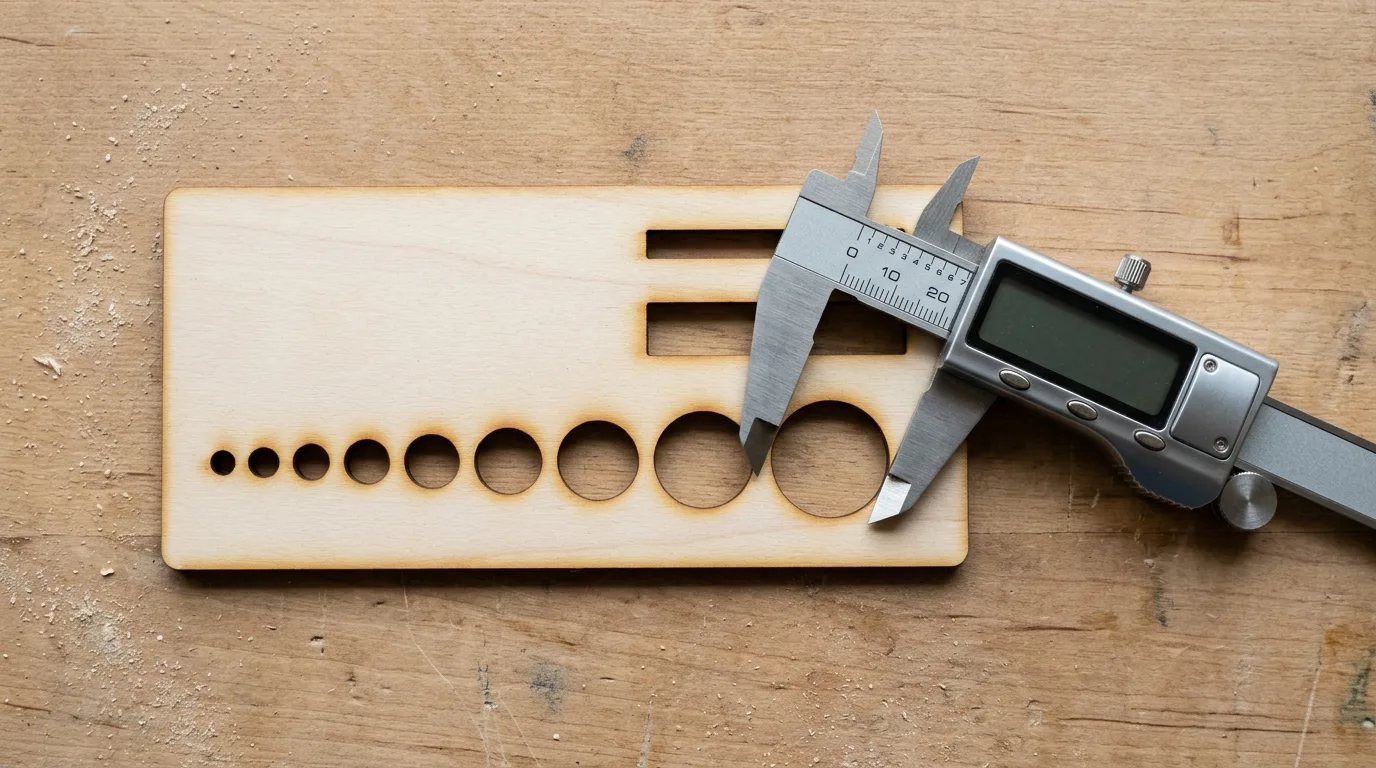
Cut a calibration plate with a range of incrementally different hole or slot widths, measure each with calipers, identify which size gives the fit you want, then apply that offset to your real CAD file before cutting the actual jig or mechanism.
Start with the nominal size of your hardware – if you’re fitting a 6mm dowel pin, cut test holes from 5.7mm to 6.3mm in 0.1mm increments. Label each hole in your vector file so you know which is which after the cut.
Measure each hole with calipers after cutting. Wood shrinks slightly as it cools and the char layer adds thickness, so the measured size won’t match the vector size. That’s fine – you’re looking for the vector size that produces the physical fit you need.
Test your actual hardware in each hole. Snug press-fit? Free-spinning with minimal slop? Note which vector dimension gave you that result, then apply that offset to your real part file. If the 6.1mm vector hole gave you a perfect slip fit for a 6mm pin, design your jig holes at 6.1mm.
I skipped the test plate once on a linkage design, cut the real part straight from CAD, and had to redo it because the pivot holes were too tight to move freely. Wasted a sheet and a chunk of an evening. Now I always test first, even if I’m “pretty sure” the offset from last time will work.
This method builds on the general laser test card practice for dialing in power and speed, but narrows it to the specific fit question that matters for functional parts. Run the test plate on a scrap corner of your working sheet, not on a different piece of material – you want to validate the exact stock you’re about to use.
Once you’ve validated general tolerance with the test-plate method, sizing holes for specific hardware like screws or Chicago screws is its own narrower question – the screw hole and hardware clearance guide covers that in detail.

Where Basswood’s Softness Helps Functional Parts – and Where It Becomes a Liability
Basswood’s softness is an advantage for press-fits, gentle mating with other parts, and forgiving minor misalignment – the grain compresses slightly when you push a dowel or bearing into a snug hole, which means you get a secure fit without the brittleness risk of acrylic. It also absorbs shock better than rigid sheet materials, so fixtures that hold workpieces don’t scratch or dent as easily.
But that same softness becomes a liability for parts under sustained load, repeated friction or wear points, or long unsupported spans. Basswood can creep over time under constant pressure and wears faster than acrylic or Baltic birch at pivot points. I built a simple linkage with basswood pivot holes, and after repeated open-close cycles the holes had visibly ovaled out – had to remake it in acrylic to keep the motion smooth.
Good uses: drill jigs, alignment fixtures, router templates, assembly clamps, and occasional-use mechanisms where the part sees light duty and you value the forgiving fit. Risky uses: gear teeth under constant load, hinges opened hundreds of times, cam followers, bearing races, or any cantilever beam longer than a few inches. When in doubt, cut a basswood prototype to validate geometry, then remake the high-stress version in a stiffer material.
Sizing Holes for Specific Hardware After You’ve Validated General Tolerance
Once you’ve run the test-plate method and validated your general tolerance offset, sizing holes for specific hardware – screw clearances, Chicago screw fit, key ring posts – is its own narrower question with material-specific recommendations. That topic is covered in detail in a separate published guide; this article focuses on the broader functional-fit validation method that applies before you get to hardware-specific dimensions.
The test-plate workflow gives you the offset you need for any arbitrary hole or slot size. Hardware sizing builds on that foundation but adds considerations like thread engagement, head countersink depth, and whether you want a slip-fit or a friction-hold.
Why Crafteker Basswood Matters for Tolerance-Sensitive Functional Work
Crafteker 3mm basswood sheets are laser-grade, void-free, and consistent in thickness sheet to sheet – which matters specifically for functional-parts work because thickness variance is one of the compounding factors that throws off a validated tolerance offset. When you cut a test plate, dial in your fit, and then cut five more jigs from five different sheets, you want those sheets to behave the same way. Crafteker delivers that consistency at $2.08/sheet in the 12-pack.
12×12 inch format fits most hobby laser beds without waste, and the pre-sanded surface means clean engraving and marking when you need to label jig positions or version numbers. If you’re building functional parts that need to mate with real hardware, material quality stops being optional.
Ready to cut jigs that actually fit? Get the consistent wood that makes tolerance validation work:
→ Buy Crafteker 12-Pack Basswood Sheets on Amazon – $24.99
Also available: 5-pack ($15.97) · 3-pack ($12.99)
Frequently Asked Questions
Can 3mm basswood plywood be used for functional mechanical parts, not just decoration?
Yes, for jigs, fixtures, templates, and occasional-use mechanisms – but you need to validate fit with a test cut first. Basswood works well under low-to-moderate load, but it has real limits for sustained stress or heavy wear compared to acrylic or Baltic birch. I built a drill-guide jig expecting it to last one weekend and ended up using it well past that before it showed any real wear.
What tolerance can I expect cutting holes and slots in 3mm basswood on a hobby laser?
Low tenths of a millimeter is a reasonable starting point, but that varies by machine, focus, power, and stock thickness – never assume a single universal number. Your diode laser will behave differently than my CO₂, and even sheet-to-sheet variance plays a role. Always cut a test plate and measure with calipers rather than trusting kerf theory alone.
How do I validate fit before cutting a real jig or mechanism?
Cut a calibration plate with a range of incrementally different hole or slot widths – I usually step mine by 0.1mm. Measure each opening with calipers, find which size gives the fit you want (snug press-fit, free-spinning, or sliding clearance), then apply that offset to your CAD file before cutting the actual part. Skipping this step once cost me two sheets on a linkage that came out too tight to pivot.
When should I use acrylic or Baltic birch instead of basswood for a functional part?
When the part sees sustained load, repeated friction or wear, or needs to span a long unsupported distance without flexing. Basswood’s softness is an advantage for press-fits and forgiving minor misalignment, but it will creep or compress under constant stress faster than harder materials. Good for a fixture you use once a week – risky for a gear tooth or hinge that cycles hundreds of times.
Where can I buy consistent basswood for tolerance-sensitive laser cutting?
Crafteker 3mm basswood on Amazon: 3-pack $12.99, 5-pack $15.97, 12-pack $24.99 ($2.08/sheet). Laser-grade, void-free, and consistent thickness sheet to sheet – which matters when you’re reusing a validated tolerance offset across multiple parts. Shop all sizes on Amazon.
About the author: Mike Dolan is a laser maker and wood materials specialist with 8+ years cutting basswood, birch, and MDF on diode and CO₂ machines. He tests every Crafteker basswood batch before listing.
I always cut a test gauge with a few different slot widths before I trust a basswood jig design – learned that the hard way on a fixture that was supposed to hold dowel pins and came out too snug. Been using Crafteker sheets for the last six months and the consistent thickness actually makes a difference when you’re reusing the same tolerance offset across multiple sheets.