

Hobby to $1K: Beginner’s Roadmap Selling Basswood in 2026
Your first $1000 from laser-cut basswood items comes from picking a few simple, repeatable products, pricing them realistically, and selling through a couple of low-friction channels – Etsy, craft fairs, social media – not from an elaborate business plan or expensive equipment upgrade. This guide walks through the realistic first products that actually work for total beginners, the honest math on how many sales that milestone actually takes, and the mistakes that slow people down before they ever make a sale.
By Mike Dolan ·
Quick Answer: Laser cut basswood plywood items to sell as a beginner: start with simple repeatable shapes, price at $15-30, sell via Etsy and craft fairs, and expect 34-67 sales to hit $1000 revenue – not profit, and timeline varies widely.
| Material | Engraving Contrast | Cut Ease | Smoke / Odor | Cost | Beginner Score |
|---|---|---|---|---|---|
| Basswood (3 mm) | ★★★★★ | Excellent – 1 pass | Low | $ | ★★★★★ |
| Baltic Birch Plywood | ★★★★ | Good – 2-3 passes | Medium | $$ | ★★★★ |
| MDF | ★★★ | Good – 1-2 passes | High (formaldehyde) | $ | ★★ |
| Pine / Soft Plywood | ★★★ | Poor – resin deposits | Medium-High | $ | ★★ |
The Realistic First Products for a Total Beginner
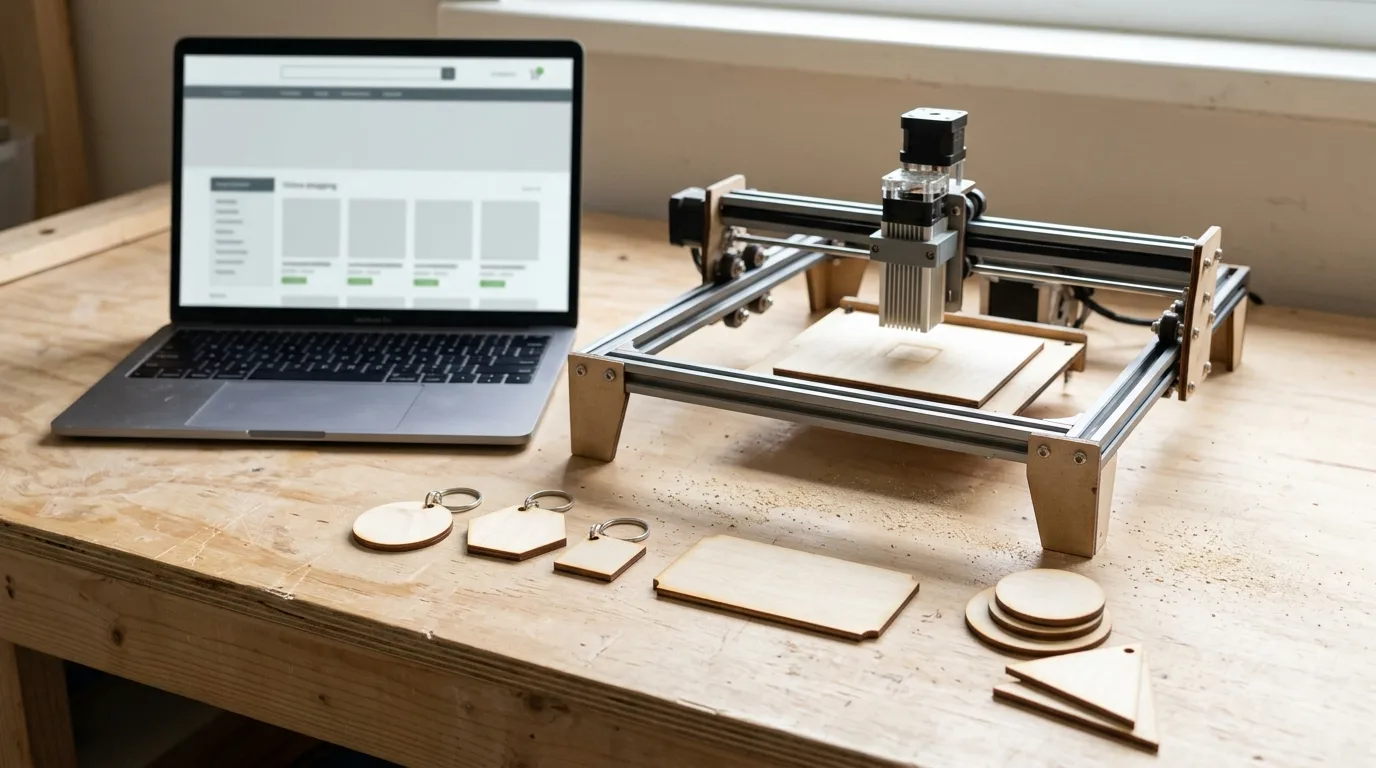
Start with geometric keychains, simple name signs, basic layered shapes, and plain decorative plaques. These low-complexity, repeatable pieces let you dial in your basswood laser cutting settings without fighting a complex design while you’re still figuring out power, speed, and focus height.
I spent the first week trying to nail an elaborate multi-layer design before making a single sale. Wasted material, burned time, no revenue. Switched to a simple repeatable geometric shape and had something sellable by the weekend.
Intricate or highly customized designs sound appealing but slow learning and create waste instead of helping you reach that first sale. You’re not learning faster by tackling a 12-layer project – you’re just burning more basswood and delaying the moment you have something finished to photograph and list.
Repeatable shapes mean you cut the same file five times, refine your technique, and build inventory. Customized work means starting from scratch on every piece, which is fine once you know your workflow but punishing when you’re still figuring out how to prevent charring when laser cutting.
Pick one or two simple designs. Cut them until you can produce clean results without hesitation. Then list them and make your first actual sale before you complicate the product line.
The Honest Math: What It Actually Takes to Hit $1000
At a beginner price point of $15-30, reaching $1000 in revenue takes about 67 sales at $15, 50 sales at $20, 40 sales at $25, or 34 sales at $30. That’s gross revenue – not take-home profit, not what lands in your account after material costs, platform fees, and your time.
No one can guarantee you a timeframe. Some beginners hit that mark in a few weeks because they’re selling at multiple craft fairs and posting daily. Others take months because they’re only working weekends or still dialing in their product line.
The math is simple: if you price a keychain at $15 and sell 67 of them, you’ve crossed $1000 in revenue. But you’ve also bought basswood sheets, paid Etsy listing fees, paid transaction fees, maybe paid for shipping supplies, and spent hours cutting, sanding, and packing.
I hit $1000 faster than I expected in sales but slower than I hoped in actual profit – turns out listing fees and material waste add up when you’re still learning. The Etsy fee stack article breaks down what actually survives as margin after platform fees, which is a more advanced question than this milestone’s simple revenue tracking.
The takeaway: celebrate the $1000 revenue milestone as proof you can make and sell something, but don’t confuse it with $1000 in your pocket. Those are two very different numbers.
Where Beginners Actually Make Their First Sales
Most beginners make their first sales through Etsy, local craft fairs and markets, friends and family, or social media – not wholesale accounts or B2B buyers. Each channel plays a different realistic role when you have zero sales history.
Etsy is where most beginners start listing, but it takes time to get discovered. A brand-new shop with no reviews and no traffic history sits buried in search results. You’ll need to be patient, write solid titles and tags, and take clean product photos.
Etsy’s advantage is that buyers are already looking for handmade items, so you’re not convincing anyone to care about laser-cut goods in the first place. The disadvantage is the wait – weeks or months before organic traffic builds enough to produce consistent sales.
Craft fairs and local markets give you instant face-to-face feedback and cash sales the same day. You set up a table, people walk by, and if your product and price make sense, they buy it on the spot. No algorithm, no shipping, no waiting.
The tradeoff is that you’re limited to your local area and whatever foot traffic that specific event draws. But for early sales and real-world validation, craft fairs are hard to beat. You’ll also learn which products people actually pick up and which ones they ignore.
Friends, family, and social media are often the very first sales – sometimes before you even have an Etsy shop live. Post a photo of what you made in a local maker group or on your personal Instagram, and someone will ask to buy one.
I made my first few actual sales to people from a local Facebook maker group before an Etsy listing ever got a click. These early sales are fast and low-friction, but they don’t scale on their own – eventually you run out of people in your immediate network.
The realistic beginner strategy is a mix: list on Etsy so you’re building search history and reviews over time, do a couple of local craft fairs for immediate cash flow and product feedback, and share your work on social media to capture those quick early wins from people who already know you.

The Mistakes That Slow Beginners Down
The four mistakes that delay your first sale: pricing too low out of fear nobody will buy, choosing intricate designs before you’ve mastered a simple repeatable shape, skipping test cuts on your actual basswood before burning a full batch, and posting blurry or poorly lit photos that make clean work look amateurish.
Pricing at $8 when your work is worth $20 doesn’t get you more buyers – it just trains the market to undervalue what you make. Start at $15-20 minimum and adjust from real feedback, not guesses.
Skipped a test cut once because I was in a hurry, ran a batch of identical pieces at settings that had worked before, and ended up with a stack that didn’t cut all the way through on one edge – the sheet had shifted slightly in the bed and nobody caught it until the batch was already done. A quick pass on a scrap corner catches this before it costs you a sheet instead of a sale.
Test your basswood laser cutting settings on a scrap corner before committing to ten identical pieces. One bad focus setting wastes an entire sheet faster than any other mistake, and beginners burn more material than they expect while dialing in power, speed, and air assist – that’s normal learning curve, not a sign you’re doing it wrong.
Good photos matter more than you think. Natural light, plain background, tight crop. Your keychains might cut clean, but if the listing photo is dim and cluttered, nobody clicks.
This Is About Your First $1000 – Not Optimizing an Established Shop
This guide covers the milestone of proving you can make and sell something – not which specific projects yield the highest margins once you’re running a dialed-in production workflow. That’s a different question with different answers.
If you’re already past the beginner stage, know your settings, and want to pick projects based on profit optimization rather than simplicity and speed to first sale, read most profitable laser cutting projects instead. It digs into margin math, material efficiency, and which designs scale best once you’ve got buyer traction.
Your first $1000 is about learning what sells, building confidence in your process, and getting real market feedback – not maximizing every dollar. Pick simple products, price them fairly, and focus on making the sale happen. Optimization comes after you’ve proven the concept.
Start with Consistent Basswood So You’re Not Fighting the Material While You Learn
Crafteker 3mm basswood sheets are laser-grade, void-free, and pre-sanded – which matters because beginners already expect to burn through some material while dialing in settings, and starting with consistent basswood sheets means fewer wasted pieces from unpredictable glue pockets or density variation on top of the normal learning curve.
At $24.99 for 12 sheets ($2.08 each), the 12-pack is the best value for someone testing products and building inventory at the same time. The uniform quality means your settings stay reliable across batches instead of needing constant re-tuning.
Ready to cut? Get the wood that works with these settings:
→ Buy Crafteker 12-Pack Basswood Sheets on Amazon – $24.99
Also available: 5-pack ($15.97) · 3-pack ($12.99)
Frequently Asked Questions
What are realistic first products to sell as a total beginner with a laser cutter?
Simple, repeatable pieces work best – geometric keychains, basic name signs, plain layered shapes, and simple decorative plaques. Intricate or highly customized designs tend to slow down learning and create more waste before your first sale. I spent a week trying to nail a complicated multi-layer piece before switching to basic shapes and actually having something ready to list.
How many sales does it actually take to make $1000 selling laser-cut items?
At a $15-30 price point, it takes roughly 67 sales at $15, 50 at $20, 40 at $25, or 34 at $30 – and that’s gross revenue, not profit. Material costs, fees, and your time still come out of that number. For the detailed breakdown of what survives after Etsy’s fee stack, see this margin guide.
Where do beginners usually make their first sales?
Most commonly Etsy, local craft fairs and markets, and friends, family, or social media – not wholesale or B2B buyers. Craft fairs and personal networks often produce the very first sales faster than a brand-new Etsy listing. I made my first three actual sales to people from a local Facebook maker group before an Etsy listing ever got a click.
How long does it take to reach $1000 in sales as a beginner?
There’s no reliable guaranteed timeframe – it depends heavily on how much time you put in, how quickly you find buyers, and how many products you’re offering. Treat any specific promised timeline with skepticism. Some people hit it in weeks, others take months.
Where can I buy consistent basswood sheets to practice on as a beginner?
Crafteker on Amazon: 3-pack $12.99, 5-pack $15.97, 12-pack $24.99 ($2.08/sheet best value), laser-grade and void-free, so the material itself isn’t adding extra waste on top of the normal beginner learning curve. Starting with consistent sheets means you’re learning settings, not fighting random voids.
About the author: Mike Dolan is a laser maker and wood materials specialist with 8+ years cutting basswood, birch, and MDF on diode and CO₂ machines. He tests every Crafteker basswood batch before listing.
I burned a week on a complicated layered design before I ever listed anything, then finally switched to basic geometric keychains and actually had something to sell. Made my first few sales at a local maker meetup before Etsy got any traction. Was surprised how many pieces it actually took to crack $1000 – I thought I’d be there faster. Crafteker sheets helped because at least the material was predictable while I figured out my settings.