
4 Differences: Craft-Store vs Laser-Grade Basswood (2026)
Laser-grade basswood holds about +/-0.15mm, while a craft-store 3mm sheet can vary from about 2.0mm to 3.5mm. You’ll see what that gap does to focus, cut reliability, moisture movement, and your material budget.
By Mike Dolan ·
Quick Answer: Craft-store basswood vs laser-grade basswood comes down to repeatability: laser-grade stock holds about +/-0.15mm and targets 6-8% moisture for steadier cuts.
| Material | Engraving Contrast | Cut Ease | Smoke / Odor | Cost | Beginner Score |
|---|---|---|---|---|---|
| Basswood (3 mm) | ★★★★★ | Excellent – 1 pass | Low | $ | ★★★★★ |
| Baltic Birch Plywood | ★★★★ | Good – 2-3 passes | Medium | $$ | ★★★★ |
| MDF | ★★★ | Good – 1-2 passes | High (formaldehyde) | $ | ★★ |
| Pine / Soft Plywood | ★★★ | Poor – resin deposits | Medium-High | $ | ★★ |
What Makes Laser-Grade Basswood Different from Craft-Store Basswood?
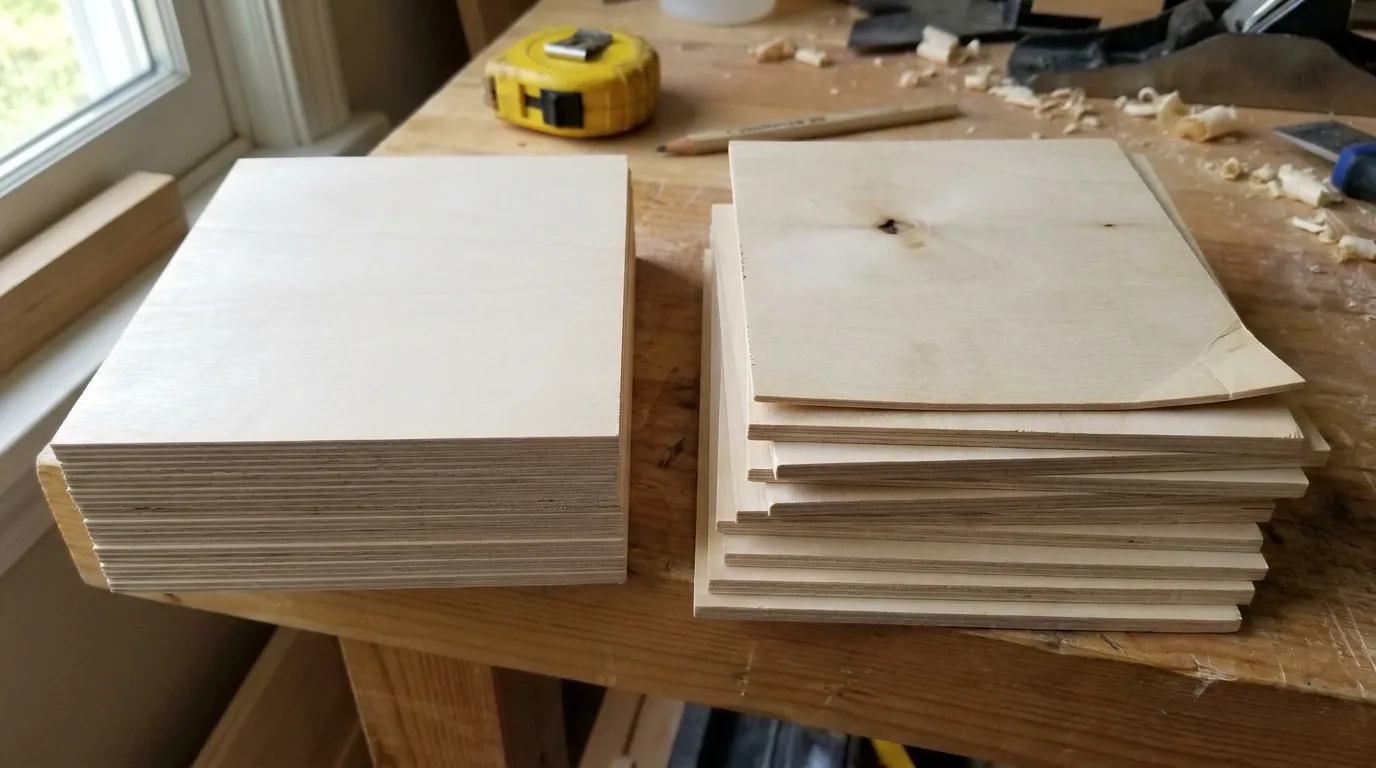
Craft-store basswood is not automatically bad; it just is not selected for a focused laser beam. Laser-grade stock is chosen for repeatable thickness, flatter faces, and more uniform grain, so the sheet behaves like material rather than a small surprise waiting under your design.
Hand-cutting can hide plenty of variation because your hand naturally compensates. A laser does not. Thickness changes shift the focal plane, while uneven density can make a delicate detail behave differently from one area of the sheet to the next.
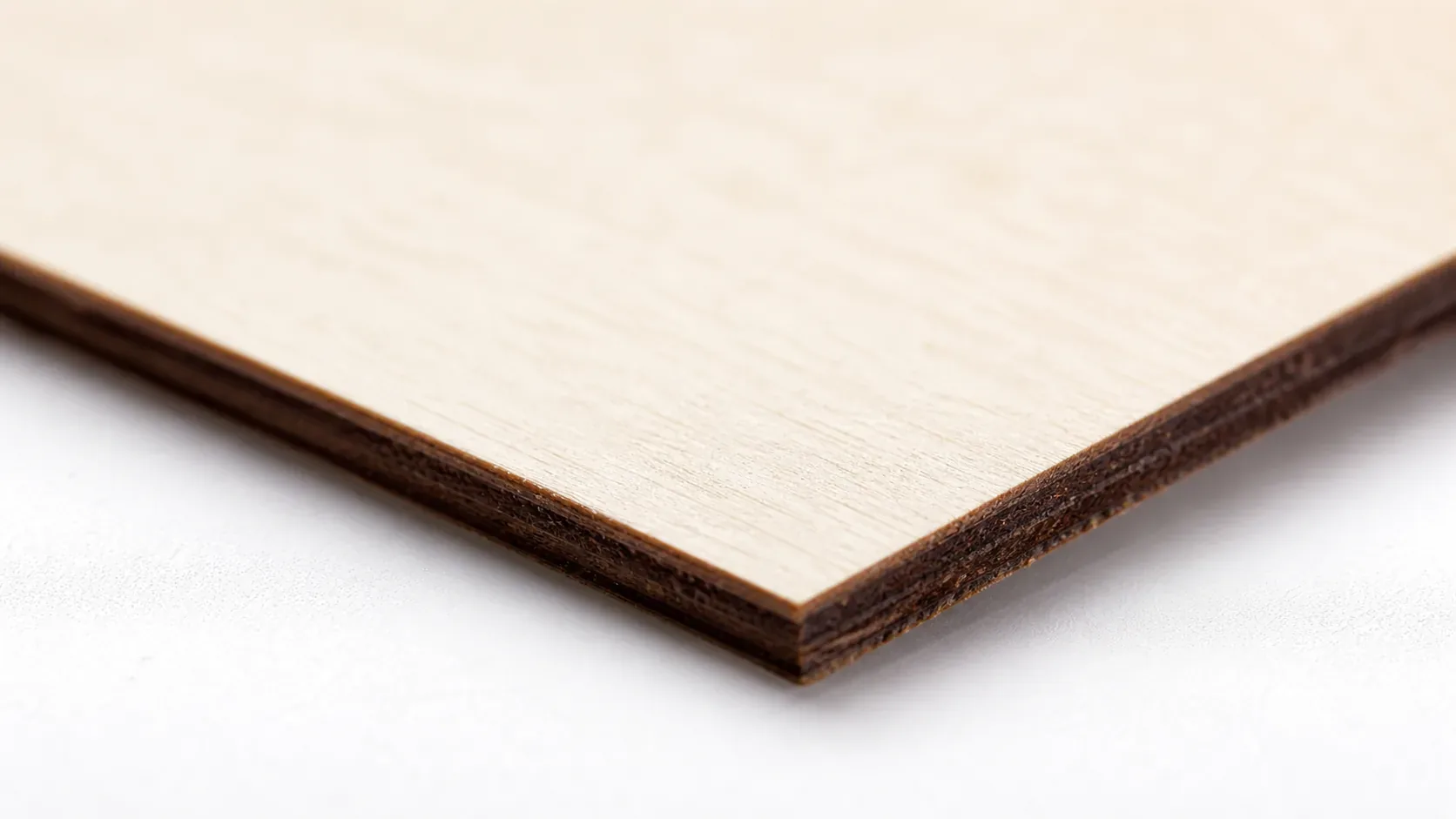
Laser-grade panels also receive more selective grain screening, with fewer knots and internal voids. Better panels commonly use phenolic-type glue rather than weaker urea-formaldehyde glue, giving the layers a steadier bond under heat instead of leaving you to discover a weak seam mid-project.
Moisture and density matter, too. USDA Forest Products Laboratory data helps explain why wood movement varies with moisture behavior, and why consistent stock is friendlier to repeat work. For buying guidance, see our best basswood sheets for laser cutting.
I grabbed a craft-store sheet for a quick job once, assuming basswood is basswood – the corner was nearly a millimeter thinner than the center, and the laser cut clean through one side while barely scoring the other. That sheet taught me to spot-check before committing a job.
Once your sheet quality is sorted, the next issue is keeping the finished edge tidy. Our guide to prevent charring when laser cutting covers the cleanup side, but no technique can make a hidden void disappear.
- Low resin – basswood is naturally low in resin, and laser-grade selection keeps that behavior more consistent from sheet to sheet.
- Consistent density – the real grade difference is predictable grain and thickness, not a lucky sheet that happens to behave well.
- Minimal internal voids – laser-grade selection rejects more defects that can cause blowouts, weak details, or incomplete cuts.
- Light, workable surface – pale faces make it easy to spot-check flatness, grain, and thickness before committing a job.
- No toxic fumes – unfinished basswood itself is suitable for indoor laser use with basic ventilation; always confirm that no coatings or unknown adhesives are present.
Thickness Tolerance and Moisture Content: The Numbers That Matter
Thickness consistency and moisture control decide whether a sheet behaves predictably or turns a simple design into scrap. Laser-grade stock is selected to stay close to its stated thickness and moisture target, while craft-store stock can vary enough across one panel to make a single focus height a bad bet.
| Factor | Laser-Grade | Craft-Store |
|---|---|---|
| Thickness Tolerance | +/-0.15mm (3mm runs ~2.8-3.2mm) | Up to ~20% variance (3mm can run ~2.0-3.5mm) |
| Moisture Content | Controlled, targets 6-8% | Often inconsistent, more prone to swings |
| Voids/Knots | Selective grain, fewer defects | More common, hit-or-miss quality |
These are general industry and market patterns, not lab measurements of a specific competitor’s stock. They explain why two pale, similar-looking sheets can act completely differently under a laser. Once your material is sorted, use the free laser settings calculator to dial in your own machine and batch.
I checked a mixed stack with calipers before a production run and found enough variation to make one focus height a bad bet. That is the trap: the sheet may look flat and tidy from above, but its thickness can wander where your design has the smallest details.
Moisture adds another moving part. A stable sheet stays flatter and keeps joined pieces behaving like they belong together. A sheet that absorbs or releases moisture unevenly can shift after you have measured, positioned, and started a job. That is not a fun surprise halfway through a matching set.
How Bad Sheets Show Up in Your Cuts
Light brown edges are normal. Bad sheets show up as uneven cut behavior across the same panel: one area cuts cleanly, another barely scores, and another chars before it releases. Uneven thickness shifts the material away from the focus point as the beam travels, so repeatability disappears even though your file has not changed.
Hidden voids and knots create a different kind of headache. A void can leave a fragile gap that breaks away too soon, while a dense knot can resist the beam and leave an incomplete cut where you expected a clean release. I had a clean-looking sheet blow out a small detail mid-cut because a hidden void was sitting right under the kerf.
Inconsistent moisture often announces itself before the laser even starts: a panel bows, curls, or refuses to sit flat. It can also move after cutting, which throws layered pieces and multi-piece work out of alignment. If parts that should stack neatly suddenly argue with each other, inspect the sheet before blaming the design.
Is Craft-Store Basswood Ever Worth It?
Yes, craft-store basswood is worth buying for hand-cutting, painting, classroom crafts, and low-stakes hobby builds where small surprises do not matter. A hand blade and paint can forgive a thin patch, a knot, or a slightly wavy panel; a focused laser beam politely exposes every one.
Lower or downgraded grades can run roughly 20-40% cheaper than laser-grade stock. The price gap has a source, but failed cuts, wasted material, and rework eat the saving quickly. I saved money on bargain sheets for a batch once, then remade enough failed pieces that the cheaper stack stopped being cheap. For Etsy sellers and repeat cutters beyond one-off experiments, choose the best basswood sheets.
Common Problems With Craft-Store Basswood on a Laser
A rough cut does not always mean your laser is the problem. It often points to material variation: thickness changes, voids, moisture movement, or glue that cannot hold together under heat. Check the sheet before blaming the machine, then compare it with your usual stock.
- Inconsistent thickness: Thickness changes across one sheet shift the focal point, leaving one area clean while another barely scores or chars.
- Hidden voids and knots: A void or knot can cause sudden burn-through, incomplete cuts, or a detail that fails without warning.
- Inconsistent moisture: Wetter or unevenly dried sheets can warp before or after cutting, throwing layered pieces out of alignment.
- Weak glue lines: Lower-grade plywood glue can delaminate or blow out at the kerf under laser heat, leaving a ragged edge.
I blamed my optics for a ragged edge until I flipped the sheet and found a glue line separating underneath it. A clean lens cannot repair a weak panel. Use the laser settings calculator after the material itself is sorted.
Where to Buy Laser-Grade Basswood
Buy Crafteker laser-grade basswood for repeatable stock. These 12×12 inch, 3mm sheets pair tight thickness tolerance and controlled moisture with void-free construction. At $24.99 for 12 sheets ($2.08/sheet), it is the most cost-effective choice for repeatable results. I started keeping one known-good sheet brand on hand after a rushed replacement sheet turned a simple rerun into an afternoon cleanup job.
Ready to cut? Get the wood that works with these settings:
→ Buy Crafteker 12-Pack Basswood Sheets on Amazon – $24.99
Clip the 7% coupon on the listing page – buy 2 packs and save 20% automatically.
Also available: 5-pack ($15.97) · 3-pack ($12.99)
Frequently Asked Questions
What’s the difference between craft-store basswood and laser-grade basswood?
Laser-grade basswood is selected for tighter thickness control, more consistent grain, stronger glue lines, and fewer voids or knots; craft-store sheets can vary by up to roughly 20% in a 3mm panel.
Does thickness tolerance really matter for laser cutting basswood?
Yes. Laser-grade stock holds roughly +/-0.15mm, while craft-store sheets can vary by up to ~20%, creating focus drift from one part of a 3mm sheet to another.
What moisture content is best for laser cutting basswood?
Around 6-8% is the general target for stable, predictable laser cutting because wetter stock is more likely to swell or warp.
Can I laser cut basswood from a craft store?
Yes, but expect less consistent results: a craft-store 3mm sheet can run about 2.0-3.5mm, which can cause focus drift, occasional burn-through, and missed cuts.
Where can I buy laser-grade basswood sheets?
Crafteker sells laser-grade basswood on Amazon in a 3-pack for $12.99, 5-pack for $15.97, and 12-pack for $24.99. The 12-pack is the best value at $2.08/sheet, and you can clip the 7% coupon on the listing page.
About the author: Mike Dolan is a laser maker and wood materials specialist with 8+ years cutting basswood, birch, and MDF on diode and CO₂ machines. He tests every Crafteker basswood batch before listing.
The thickness-tolerance and moisture figures here are general industry patterns, not lab measurements of any specific competitor’s craft-store product. Craft-store sheets can still be perfectly fine for painting, hand-cutting, and non-laser hobby work.