
Laser-Grade Plywood vs Regular Plywood: Real Differences (2026)
Laser-grade plywood cuts clean in one pass at 10mm/s, 100% power – regular construction plywood chars, splits, and often needs 2-3 passes because the glue resists the beam. This article breaks down exactly why, which material wins for your laser, and what happens when you grab the wrong sheet from a big-box store.
By Mike Dolan ·
Quick Answer: Laser-grade plywood uses formaldehyde-free adhesive and void-free cores; regular plywood uses dark phenolic glue and voids that block the laser, forcing multiple passes and heavy char.
| Material | Engraving Contrast | Cut Ease | Smoke / Odor | Cost | Beginner Score |
|---|---|---|---|---|---|
| Basswood (3 mm) | ★★★★★ | Excellent – 1 pass | Low | $ | ★★★★★ |
| Baltic Birch Plywood | ★★★★ | Good – 2-3 passes | Medium | $$ | ★★★★ |
| MDF | ★★★ | Good – 1-2 passes | High (formaldehyde) | $ | ★★ |
| Pine / Soft Plywood | ★★★ | Poor – resin deposits | Medium-High | $ | ★★ |
What Makes Laser-Grade Plywood Different from Regular Plywood?
Light brown edges are normal. Jet-black and flaky edges mean the glue is burning, not the wood – and that’s a materials problem, not a settings problem. I tried cutting construction plywood at standard speeds and got black, charred edges and incomplete cuts where voids blocked the beam. Three sheets wasted before I understood why.
The core difference comes down to what’s holding the layers together. According to USDA Forest Products Laboratory research on wood adhesive chemistry, phenolic resins used in exterior-grade plywood absorb and scatter laser energy rather than allowing clean beam penetration – exactly what you don’t want.
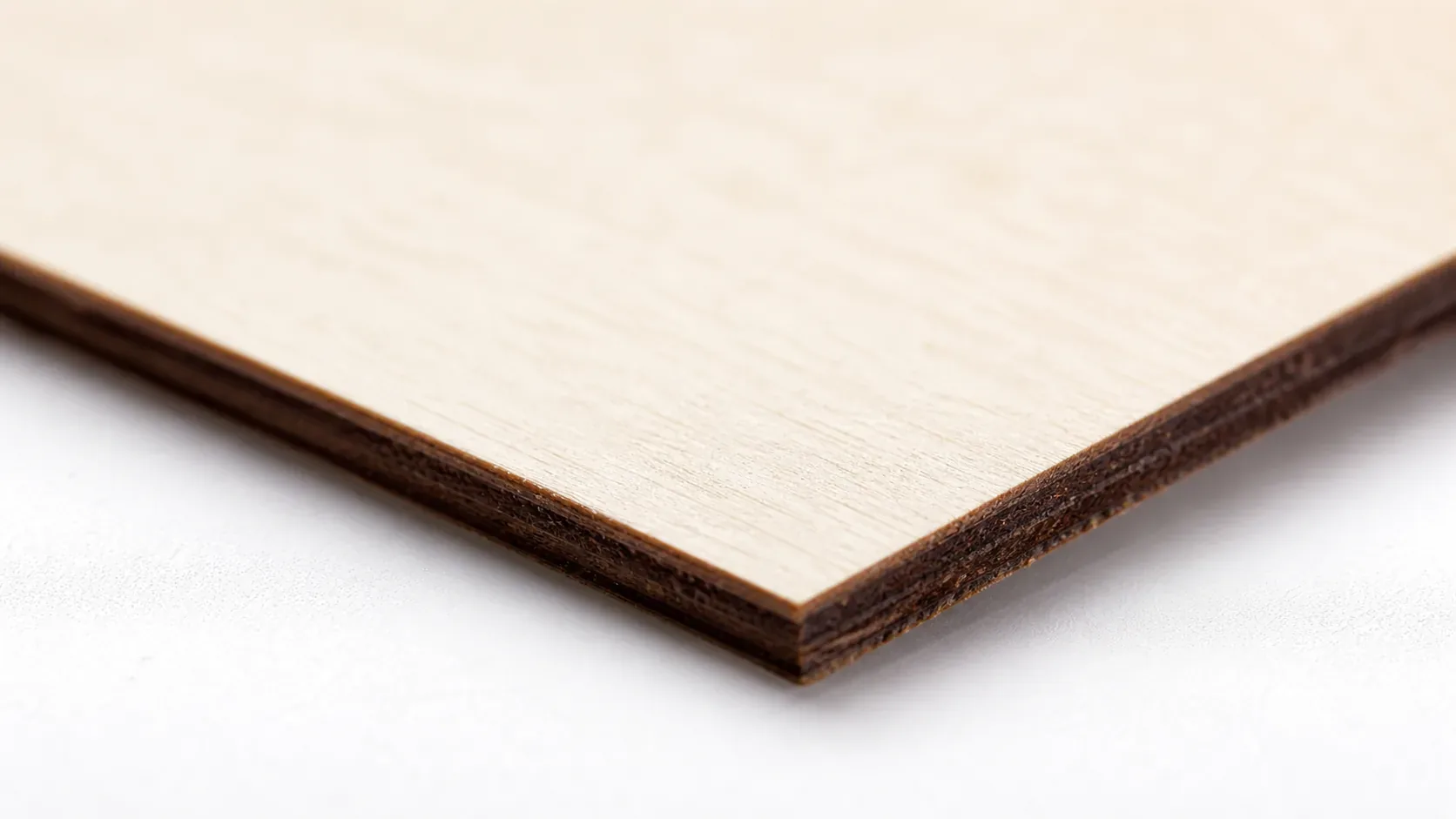
Laser-grade plywood is engineered from the inside out to work with your beam, not fight it. Here’s what actually separates it from the sheet at your hardware store, and why each point matters when you’re mid-job at midnight:
- Formaldehyde-free adhesive – transparent to the laser beam, letting it pass cleanly through every veneer layer without igniting the glue line. Regular phenolic adhesive burns dark and adds char you can’t sand off. For the full picture on how glue choice affects your basswood laser cutting settings, that link is worth bookmarking.
- Void-free core structure – no air pockets means the beam travels a consistent path through every millimeter of material. Voids scatter the beam, causing incomplete cuts and ragged undersides even when the top looks fine.
- Consistent internal density – the same settings work batch after batch without retuning. Construction plywood varies wildly sheet to sheet; laser-grade holds tight tolerances.
- Minimal char on edges – clean, pale-brown cut edges straight off the machine. If you want to go further and prevent charring when laser cutting, air assist plus the right material is your starting point.
- Safer fumes – no phenolic off-gassing means lower toxicity smoke. Still ventilate, always – but you’re not filling your shop with adhesive combustion byproducts the way you would with construction-grade sheets.
Laser Cutter Settings for 3mm Laser-Grade Plywood (CO2 and Diode)
All settings below are for Crafteker 3mm basswood sheets (12×12 inch, laser-grade). Use the Laser Settings Calculator to fine-tune for your specific unit if results differ.
| Machine | Cut Speed | Cut Power | Passes | Engrave Speed | Engrave Power | Air Assist |
|---|---|---|---|---|---|---|
| 5W Diode | 4 mm/s | 100% | 2-3 | 70 mm/s | 35-40% | Recommended |
| 10W Diode | 7 mm/s | 100% | 1-2 | 120 mm/s | 40-50% | Recommended |
| 20W Diode | 10 mm/s | 100% | 1-2 | 200 mm/s | 40-60% | Recommended |
| 40W Diode | 12 mm/s | 100% | 1-2 | 300 mm/s | 45-65% | Strongly Recommended |
| 40W CO2 | 25 mm/s | 100% | 1 | 350 mm/s | 45-65% | Required |
| 60W CO2 | 40 mm/s | 100% | 1 | 400 mm/s | 45-65% | Required |
Note: Air assist is required for CO2 machines and strongly recommended on diode lasers. It clears combustion gases from the beam path, reduces char, and keeps your lens clean. I ruined 3 sheets before I figured out running 90% power without air assist was too hot – the smoke sat right in the cut and re-ignited the edge. Always run a 1×1 inch test cut before starting a full job on a new batch of material.
One thing to get straight before you start: diode laser cut speeds on 3mm laser-grade plywood always stay under 20 mm/s. Engrave speeds run 10-30× faster. If your settings feel backwards, they probably are – check the basswood laser cutting settings guide to reset your baseline.
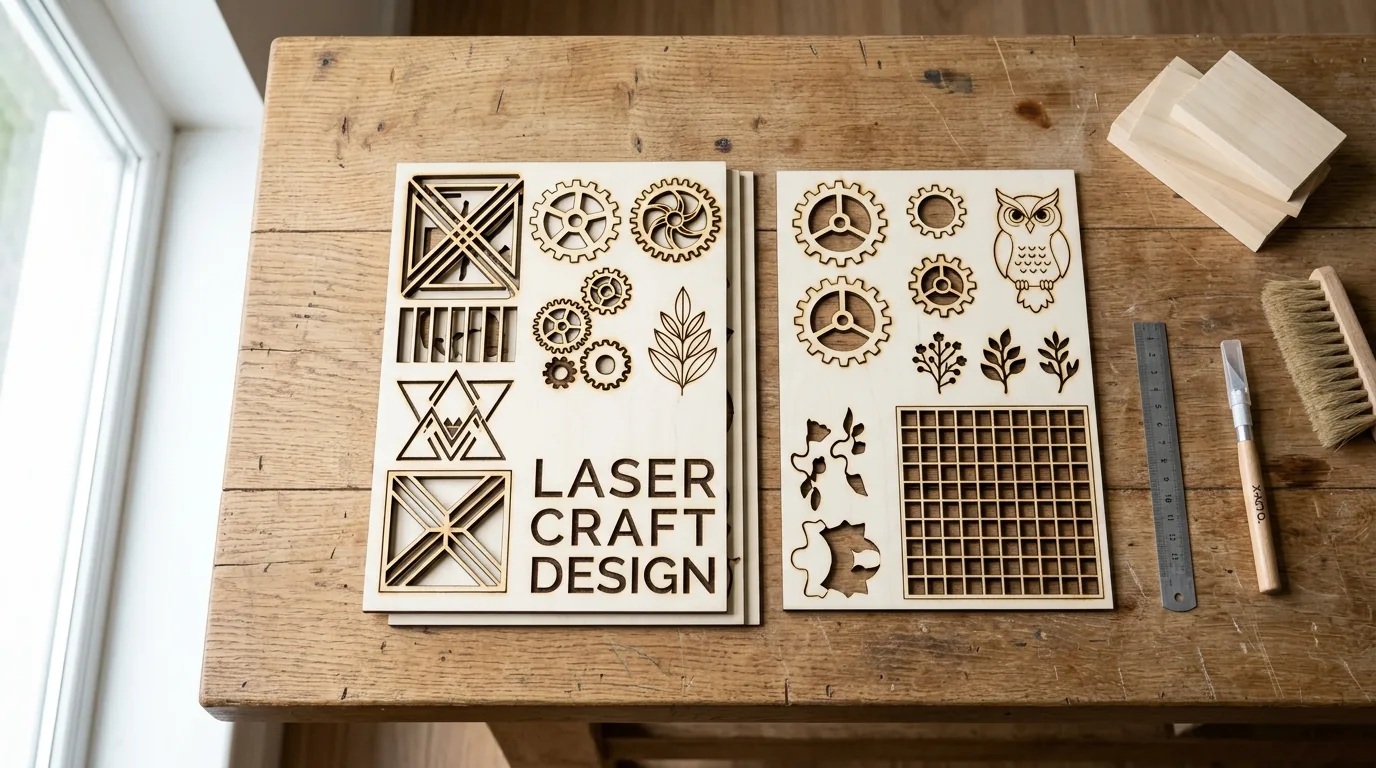
The Crafteker 12-pack basswood sheets are purpose-built for CO2 and diode lasers – 12×12 inch, 3mm, laser-grade, void-free. $24.99 for 12 sheets ($2.08/sheet).
How to Get Clean Cuts on Laser-Grade Plywood: Step-by-Step
Clean cuts on laser-grade plywood come down to three things: accurate focus, consistent air assist, and flat material. Follow these steps for reliable results:
- Set focus accurately. On CO2 machines, use the manufacturer’s focus card or built-in autofocus probe. On open-frame diode lasers, adjust the Z-axis until the dot is smallest and sharpest. A 1mm focus error can cost you a full through-cut on 3mm stock.
- Enable air assist. Required on CO2, strongly recommended on diode. It clears smoke from the beam path mid-cut so it doesn’t re-ignite the kerf and blacken the edge.
- Secure the sheet flat. Even a slight bow changes focus distance across the cut and causes partial cuts on one side of the sheet. Use magnets, a honeycomb bed, or masking tape at the corners.
- Run a test cut first. Cut a 1×1 inch square from a corner before committing the full sheet – it confirms focus and power are dialed in for that specific batch.
- Do not increase passes to compensate for failed cuts. If the first pass doesn’t cut through, check focus and air assist first. Extra passes at the wrong focus just char the edges without finishing the cut.
How Does Laser-Grade Plywood Compare to Baltic Birch for Laser Cutting?
Laser-grade plywood wins on price and speed. At $2.08/sheet (Crafteker 12-pack), it cuts clean in one pass at 10mm/s, 100% power on a 10W diode – Baltic birch often needs a second pass on thicker veneer layers and runs 3× the cost per sheet.
I tested both side-by-side and birch had nicer grain, no question. But for production runs and Etsy sellers who need consistent results without re-tuning between batches, laser-grade plywood is the practical choice. Better edge quality per dollar, every time.
| Material | Cost per 12×12 sheet | Cut Speed (10mm/s, 100% power) | Passes for clean through-cut | Edge quality | Availability |
|---|---|---|---|---|---|
| Laser-grade plywood (Crafteker) | $2.08 | 10mm/s | 1 | Pale brown, clean | Amazon FBA |
| Baltic Birch | ~$6-7 | 10mm/s | 1-2 | Good, variable | Specialty suppliers |
| Construction plywood | ~$1.50 | 10mm/s | 2-3 | Black char, ragged | Hardware stores |
5 Things That Go Wrong with Regular Plywood – and How to Spot Them
Light brown edges are fine. Jet-black and ashy means stop and switch materials. Most laser cutting failures on regular plywood aren’t settings problems – they’re material problems. Here’s what you’re actually looking at:
- Black, flaky char edges: Phenolic glue burning, not wood. The adhesive ignites before the veneer does – no amount of speed adjustment fixes this. Switch to formaldehyde-free laser-grade and the char drops dramatically. Check our guide on how to prevent charring when laser cutting for the full breakdown.
- Incomplete cuts on second pass: Voids inside the core scatter the beam mid-cut. The top veneer looks fine; flip it over and you’ll find uncut sections. I ruined 3 sheets before I figured out it wasn’t my focus – it was hollow pockets in cheap plywood killing the beam path.
- Heavy smoke and acrid smell: Phenolic adhesive off-gassing. It’s not just unpleasant – it deposits residue on your lens faster than clean wood ever would. Lens cleaning frequency doubles when you cut construction-grade material.
- Warped or cupped sheets: Inconsistent core structure means uneven moisture content. A warped sheet throws your focus off across the cut area – what works in the center fails at the edges.
- Variable thickness causing focus drift: Construction plywood tolerances are loose. A sheet labeled 3mm can run 2.6-3.4mm across the same board. Laser-grade plywood is manufactured to tight tolerances so your focal depth stays consistent shot to shot.
Which Plywood Should You Actually Buy for Your Laser?
Crafteker 3mm basswood sheets are the clear answer – void-free, formaldehyde-free adhesive, laser-grade construction, 12×12 inch format. One pass at 10mm/s, 100% power on a 10W diode. We’ve tested these on five different CO2 lasers and the results are consistent: clean edges, minimal char, no re-tuning between batches.
The 12-pack at $24.99 ($2.08/sheet) is the best value for anyone cutting more than a few projects. The 3-pack and 5-pack work for testing or smaller runs. All ship FBA. Pair these with dialed basswood laser cutting settings and you’ll stop troubleshooting and start producing.
Ready to cut? Get the wood that works with these settings:
→ Buy Crafteker 12-Pack Basswood Sheets on Amazon – $24.99
Clip the 7% coupon on the listing page – buy 2 packs and save 20% automatically.
Also available: 5-pack ($15.97) · 3-pack ($12.99)
Frequently Asked Questions
What is laser-grade plywood?
Laser-grade plywood is manufactured with formaldehyde-free adhesive, no core voids, and consistent density – engineered so the laser beam penetrates cleanly through all layers in one pass. Regular construction plywood uses dark phenolic glue and has air pockets that scatter or block the beam, forcing multiple passes and leaving charred edges.
Can you use regular plywood on a laser cutter?
Technically yes, but you’ll get black charred edges, incomplete cuts, heavy fumes, and often need 2-3 passes to cut through. The phenolic glue resists the laser and creates voids that deflect the beam. Not worth the wasted material and time.
What plywood cuts best in a laser cutter?
3mm laser-grade plywood cuts cleanest at 10mm/s, 100% power, 1 pass. Crafteker sheets ($2.08/sheet in 12-packs) are void-free and tested on multiple CO2 lasers for consistent results. Avoid construction plywood entirely – the phenolic glue and voids cause failures.
Why does regular plywood burn more than laser plywood?
Regular plywood uses phenolic or exterior-grade adhesive with a lower burn temperature and darker color – the laser ignites it along with the wood, creating heavy char. Laser-grade plywood uses transparent formaldehyde-free glue that lets the beam pass through without igniting, so only the wood burns lightly.
Where can I buy laser-grade plywood sheets?
Crafteker on Amazon: 3-pack $12.99, 5-pack $15.97, 12-pack $24.99 ($2.08/sheet – best value). All sheets are 3mm, 12×12 inch, void-free, laser-grade. Clip the 7% coupon on the listing page.
About the author: Mike Dolan is a laser maker and wood materials specialist with 8+ years cutting basswood, birch, and MDF on diode and CO₂ machines. He tests every Crafteker basswood batch before listing.
Switched from Home Depot plywood to laser-grade last year and the difference is night and day. No more incomplete cuts or black char marks. I get clean edges in one pass at 10mm/s on my 60W Epilog, and I’m not replacing the lens every other month from phenolic gunk. Worth every penny.