

Selling Laser-Cut Basswood Wholesale to Boutiques: 2026 Guide
Selling laser-cut 3mm basswood items wholesale to boutiques means pricing around the keystone convention – roughly half your retail price – setting a minimum order quantity so small orders don’t eat your margin, and switching to bulk-friendly packaging instead of individual gift wrapping; it’s a real shift from direct-to-consumer selling, not just a bigger version of it. You’ll get the pricing convention handmade wholesale guides actually reference, realistic MOQ starting points, line sheet basics that separate a professional pitch from an ad-hoc one, and how to check you actually have the capacity before saying yes to a wholesale account.
By Mike Dolan ·
Quick Answer: Selling laser-cut basswood items wholesale to boutiques uses keystone pricing (roughly COGS x2 = wholesale, wholesale x2 = retail), MOQs around $100-200 or 6-12 units per style, bulk case-pack packaging, and a line sheet – guidelines not universal rules, check your capacity first.
| Material | Engraving Contrast | Cut Ease | Smoke / Odor | Cost | Beginner Score |
|---|---|---|---|---|---|
| Basswood (3 mm) | ★★★★★ | Excellent – 1 pass | Low | $ | ★★★★★ |
| Baltic Birch Plywood | ★★★★ | Good – 2-3 passes | Medium | $$ | ★★★★ |
| MDF | ★★★ | Good – 1-2 passes | High (formaldehyde) | $ | ★★ |
| Pine / Soft Plywood | ★★★ | Poor – resin deposits | Medium-High | $ | ★★ |
Wholesale pricing works backward from cost, not forward from your Etsy price
The widely referenced convention in handmade goods is keystone pricing, where a retailer roughly doubles your wholesale price to reach their retail shelf price. You’ll commonly see it described as COGS x2 = wholesale, wholesale x2 = retail.
It’s a guideline, not a universal rule. Some higher-cost items need modified markups to stay profitable, especially when material cost eats a bigger percentage of the selling price or when intricate work pushes labor hours higher.
I quoted a boutique buyer a price close to my Etsy retail out of habit on my first wholesale inquiry, watched the conversation go totally quiet, and realized a week later that wholesale math starts from your cost of goods, not from what you’re used to charging a direct customer. The buyer expected keystone, I offered a modest discount off retail instead, and there was no common ground.
Here’s the working math: if your material and direct labor cost for a set of laser-cut basswood coasters is $4, keystone convention suggests a wholesale price around $8 and a suggested retail price around $16. That $8 wholesale lets the boutique mark it up to $16 and keep their half for rent, staff, and margin.
Your Etsy retail price might currently be $18 or $22, but wholesale buyers aren’t comparing to that number. They’re thinking about what margin they need to make stocking your product worth the shelf space and onboarding effort.
If your current retail price is way above the keystone-implied number, you have room to wholesale profitably. If your retail price barely clears double your cost, wholesale at keystone may not work without redesigning the product or cutting cost somewhere sustainable.
Run the numbers on your actual laser-cut items before you quote a buyer. Calculate true COGS including material waste, laser time, finishing, and your hourly labor rate, then check whether wholesale at roughly half your retail price still leaves you a margin you can live with at higher volume.
Why boutiques expect a minimum order quantity and where to start yours
A minimum order quantity (MOQ) is the smallest dollar amount or unit count you’ll accept for a wholesale order. Boutiques expect one because onboarding a new maker takes their time too – shelf space allocation, new vendor paperwork, staff training on the product – and they batch decisions to manage that overhead.
Handmade wholesale guides commonly suggest starting MOQs around $100-200 for a first order, or roughly 6-12 units per style. That’s a guideline, not a rule. The right number depends on your production reality: how long it takes to laser-cut, finish, and pack that order, and what you need to earn per hour of shop time to keep the lights on.
I accepted an order for a handful of units below any real minimum just to get the first wholesale account, then realized the packing and shipping time cost more than the sale was worth. The excitement of “my first boutique” disappeared fast when I did the post-mortem math and saw I’d worked for less than minimum wage on that order.
Set your MOQ by calculating what an order needs to gross to cover material, laser time, finishing, packing, and a reasonable rate for your own labor – not just your material cost. If a $100-200 first order still leaves you scrambling to break even once you count the actual time it took to produce and pack it, raise the minimum until it doesn’t.
You can tier the MOQ: $200 minimum for a first order to offset onboarding effort, then $150 for reorders once the buyer is trained and you’ve dialed in the workflow. Some makers set a per-style minimum – say, 6 units per design – to avoid tiny mixed orders that fragment laser time across too many file swaps and material repositions.
Test your MOQ with one or two accounts before you commit to it in a printed line sheet. If three buyers in a row ask for half your stated minimum, either your number is too high for the market or you’re pitching stores that aren’t a fit for handmade pricing. Adjust based on what actually closes, not what sounds impressive.
The wholesale line sheet: what boutiques need to see before they order
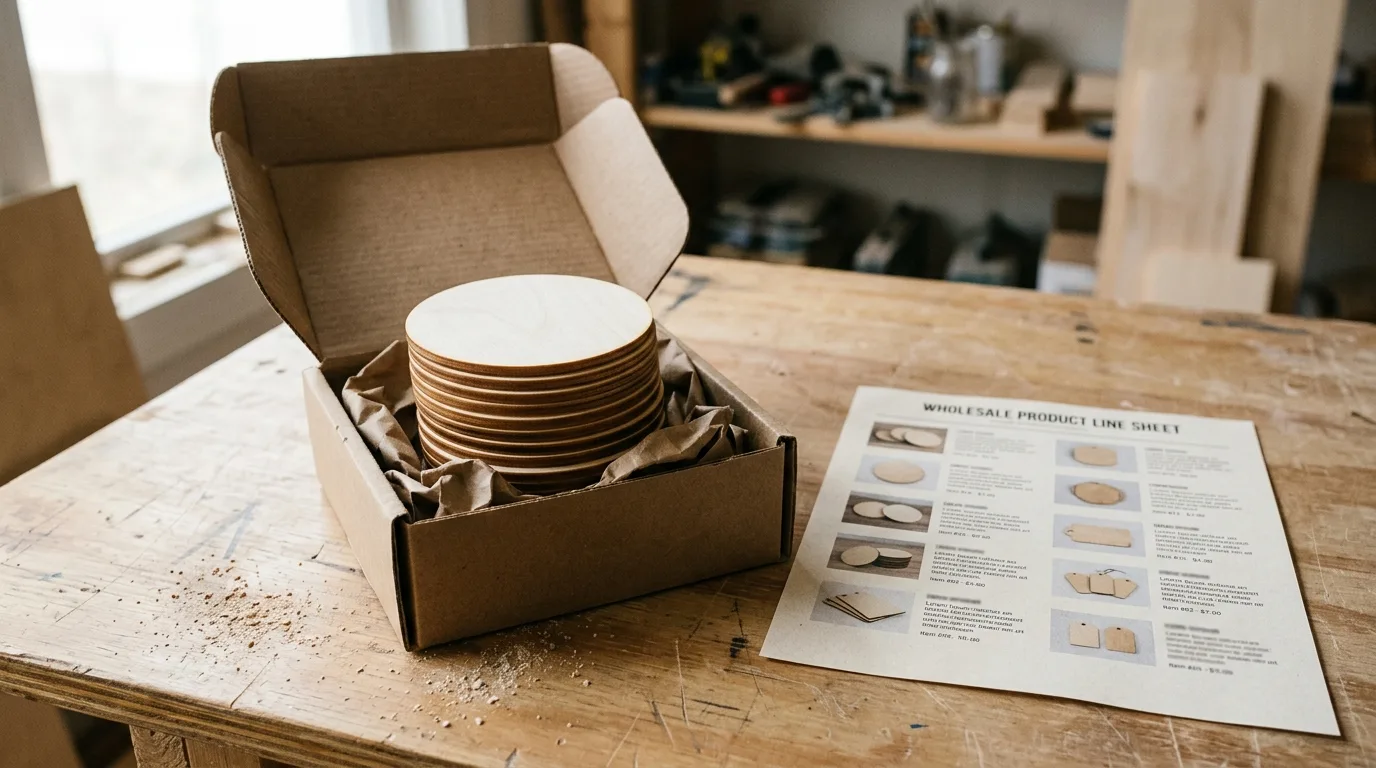
A wholesale line sheet or catalog is the document a boutique buyer uses to decide whether to place an order. It usually includes clear product photos, SKU numbers, wholesale price, suggested retail price (MSRP), MOQ per style, case pack info if relevant, lead times, payment terms, and ordering instructions – presented in a simple grid layout, typically as a clean PDF or digital sheet.
This is the professional first impression that separates a serious wholesale pitch from an ad-hoc one. A buyer reviewing twenty line sheets a week will skip yours if they have to email back and ask for the wholesale price or guess at your MOQ. Make the decision easy: every critical number visible in one document.
Your wholesale price and MSRP should reflect the keystone convention if you’re using it – roughly COGS x2 for wholesale, wholesale x2 for retail – but state both explicitly. Don’t make the buyer reverse-engineer your pricing structure. If you’re selling coasters at $6 wholesale with an MSRP of $12, write both numbers in adjacent columns.
SKU numbers matter more at wholesale scale than they do on Etsy. A boutique reordering six months later needs a shorthand reference that isn’t “those round ones with the geometric pattern.” Assign a simple, memorable SKU: COAST-GEO-RND, not BW-2024-0347-REV2.
Lead times should stay qualitative unless you’re absolutely certain of the number. “Ships within 2-3 weeks of order confirmation” is safer than “14 days” if your laser schedule varies or you’re waiting on a basswood restock. Overpromising a lead time and missing it costs you the account. Underpromise, ship early, and you’re a hero.
Payment terms are usually net 30 for established wholesale relationships, but many handmade sellers require 50% deposit upfront for first orders, with the balance due before shipping. State it clearly: “First order: 50% deposit, balance due before shipment. Reorders: net 30.” If you only accept certain payment methods – wire transfer, check, specific invoicing platforms – list them.
Keep the layout simple: a grid with one product per row, or a tiled layout with one product per block if you need larger photos. Export as PDF, name it clearly (YourBrandName_Wholesale_LineSheet_2026.pdf), and keep file size under 5 MB so it doesn’t bounce in email. Update it every time pricing, MOQs, or lead times change, and date the document so buyers know they’re looking at current info.

Bulk packaging: case packs beat individual gift boxes at wholesale scale
Bulk wholesale orders use simplified, protective case-pack packaging – multiple laser-cut basswood items stacked in one shipping box with protective wrap between layers – rather than individual gift-ready wrapping for every single piece.
This cuts packing cost and time significantly while still protecting your products in transit. I shipped my first wholesale order in the same individual gift packaging I used for Etsy orders, and packing that many boxes by hand ate an entire weekend that a bulk case-pack approach would have saved.
A typical case pack for laser-cut items stacks identical pieces with tissue or kraft paper between layers, then secures the stack in a corrugated shipper with corner bracing. The boutique unpacks the case and shelves units individually – they don’t need or want pre-wrapped retail packaging at this stage.
For mixed SKU orders, you can still case-pack by style: one box per design, labeled clearly on the outside. The shift from gift-box-per-unit to case-pack-per-style is what makes wholesale packing feasible at volume without hiring help or burning weekends on tissue paper and ribbon.
Check your actual capacity before you commit to a wholesale account
Before you say yes to a wholesale account, honestly assess how much you can produce given your laser time, finishing steps, and packing capacity, then compare that against your existing Etsy and craft-fair demand.
Model what a typical wholesale order at keystone pricing and your chosen MOQ actually nets after material cost, labor, and packing. If you’re running keystone pricing correctly, wholesale margin per unit is lower than direct-to-consumer margin – so a large wholesale order at thin margin can crowd out higher-margin retail sales if you don’t have the capacity for both.
Check that your bulk basswood sourcing is reliable at scale. If your supplier goes out of stock or inconsistent halfway through a wholesale commitment, you can’t deliver on the lead time you quoted, and that damages the account more than never taking it in the first place.
The separate question of what survives as margin on the direct-to-consumer side – Etsy fees, payment processing, shipping – is covered in detail in this margin breakdown article, and it’s worth cross-checking that math against your wholesale numbers to see which channel actually pays better for your specific products and production setup.
Why consistent basswood sourcing matters when you’re quoting lead times to boutiques
Crafteker 3mm basswood sheets are laser-grade, void-free, and consistent sheet-to-sheet – which matters here because a wholesale account depends on reliable material sourcing at scale. If your basswood supply is inconsistent, you can’t confidently commit to a boutique’s MOQ and lead time.
At $24.99 for 12 sheets ($2.08/sheet), the 12-pack is the most cost-effective option for wholesale production volume. The uniform quality means you’re not re-tuning settings mid-run or scrapping sheets with hidden voids that blow out during cutting.
Ready to scale? Get the wood that works consistently, order after order:
→ Buy Crafteker 12-Pack Basswood Sheets on Amazon – $24.99
Also available: 5-pack ($15.97) · 3-pack ($12.99)
For broader project planning once you already know what you’re selling wholesale, this guide to profitable laser cutting projects covers which specific designs tend to have the best retail margins across different product categories.
Frequently Asked Questions
How much lower should wholesale pricing be than my retail price?
The common convention in handmade goods is keystone pricing – roughly half your retail price, often described as COGS x2 = wholesale and wholesale x2 = retail. It’s a widely used guideline, not a fixed rule, and some higher-cost items may need a different markup to stay profitable.
What is a minimum order quantity (MOQ) and why do boutiques expect one?
An MOQ is the smallest order size you’ll accept from a wholesale buyer, in units or dollar value. Boutiques expect one because onboarding a new maker takes their time and shelf space too – handmade sellers commonly start around $100-200 per first order or 6-12 units per style, then adjust based on their own production reality.
What does a wholesale line sheet need to include?
Clear product photos, SKUs, wholesale price, suggested retail price (MSRP), MOQ per style, case pack info if relevant, lead times, payment terms, and ordering instructions – usually laid out in a simple grid as a clean PDF.
Do wholesale orders need different packaging than retail orders?
Generally yes – bulk wholesale orders typically use simplified, protective case-pack style packaging for stacked units rather than individual gift-ready wrapping for every single piece, which saves time and cost while still protecting items in transit.
Where can I source reliable basswood sheets for a wholesale-scale operation?
Crafteker on Amazon: 3-pack $12.99, 5-pack $15.97, 12-pack $24.99 ($2.08/sheet best value), laser-grade and void-free with consistent thickness sheet to sheet, so material inconsistency isn’t the reason you can’t commit to a boutique’s order.
About the author: Mike Dolan is a laser maker and wood materials specialist with 8+ years cutting basswood, birch, and MDF on diode and CO₂ machines. He tests every Crafteker basswood batch before listing.
I quoted a boutique buyer something close to my Etsy price on the first wholesale inquiry and got total silence back – took me a week to figure out keystone pricing was the convention. Set an MOQ after that so tiny orders stopped eating margin on packing time alone. Crafteker’s consistency means I can actually commit to a boutique’s lead time without worrying the next batch of sheets will behave differently mid-run.