

Basswood Shipping-Survivable Width: 2026 Design Guide
A basswood feature that cuts cleanly at the 1.5mm-rule minimum can still snap in a padded envelope – shipping-survivable width typically needs roughly 1.5x to 3x that cutting floor, depending on grain orientation, geometry, and packaging, not a single fixed number. This guide walks through the design principles and mitigations that let you keep delicate aesthetics without arrivals in pieces.
By Mike Dolan ·
Quick Answer: Minimum cross-section width basswood shipping survival runs roughly 1.5x-3x the pure cutting minimum – cutting clean and surviving transit are different problems, and geometry, grain, and packaging all matter.
| Material | Engraving Contrast | Cut Ease | Smoke / Odor | Cost | Beginner Score |
|---|---|---|---|---|---|
| Basswood (3 mm) | ★★★★★ | Excellent – 1 pass | Low | $ | ★★★★★ |
| Baltic Birch Plywood | ★★★★ | Good – 2-3 passes | Medium | $$ | ★★★★ |
| MDF | ★★★ | Good – 1-2 passes | High (formaldehyde) | $ | ★★ |
| Pine / Soft Plywood | ★★★ | Poor – resin deposits | Medium-High | $ | ★★ |
Cuttable Is Not the Same as Shippable
A feature can cut clean at the 1.5mm minimum feature size rule and still snap the first time it’s boxed up and shipped. That published rule is the floor, not the ceiling – it tells you what the laser can physically cut through, not what will survive three days bouncing around in a delivery truck.
The technical cutting limit sits around 0.5 to 1.0mm feature size, roughly 1x material thickness for 3mm basswood. I’ve cut filigree lettering with connectors that thin plenty of times. They came off the bed looking flawless, sharp edges, no char.
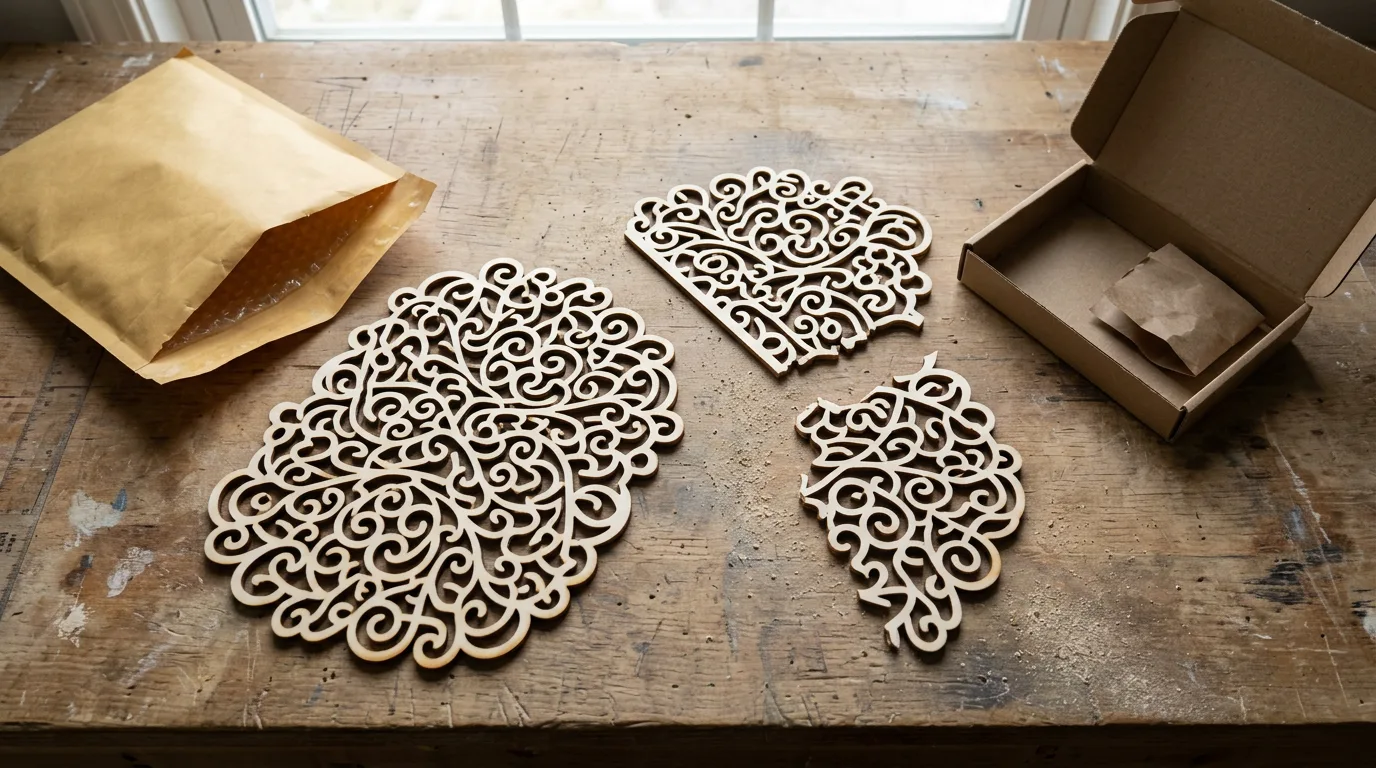
Then I boxed one up in a padded envelope for a customer and it arrived snapped in three places. Ask me how I know padded envelopes aren’t padded enough for delicate work.
Cutting is a single clean pass. Shipping is repeated bending, impact, and vibration over days of handling. Different stress, different failure mode, different design requirements. You need a wider margin to account for that.
Why Basswood Gives You Predictable Durability Margins
Basswood’s consistent density and low resin content make it one of the most predictable hardwoods for laser work. According to USDA Forest Products Laboratory data, basswood ranks among the lowest-resin domestic hardwoods, which translates to cleaner cuts and more uniform grain structure sheet to sheet.
That consistency matters when you’re designing around a durability margin. With best basswood sheets for laser cutting, the numbers in this guide hold up batch after batch instead of you guessing at each new sheet whether a thin bridge will snap or survive.
- Low resin – produces clean cuts with minimal char and no lens deposits that force you to stop mid-run
- Consistent density – the same basswood laser cutting settings work batch after batch without retuning
- Minimal char – produces clean cut edges with air assist enabled, so you spend less time sanding
- Light, workable surface – easy to sand, paint, or stain after cutting without fighting resin bleed or uneven absorption
- No toxic fumes – unlike MDF or treated plywood, safe for indoor use with basic ventilation and no formaldehyde off-gassing
The Wider Margin: Shipping-Survivable Width vs. Cutting Width
Here’s the rule of thumb: shipping-survivable width typically runs 1.5x to 3x the pure cutting minimum, or roughly 1.5x to 2x material thickness for exposed vulnerable details. That’s a range, not a fixed number – geometry, grain orientation, and packaging all shift where you land.
Why the wider margin? Cutting is a single clean pass through stationary material. Shipping is days of vibration, drops, package compression, and bending loads during sorting and handling. A 2mm bridge might laser perfectly but flex past its breaking point the first time a sorting conveyor drops the box.
Bending and impact stress concentrate at narrow cross-sections differently than the thermal cut zone does. The laser vaporizes material in a controlled line; transit loads bend the whole part repeatedly until something snaps. Different failure mode, different design floor.
This doesn’t mean you can’t ship delicate work – it means you account for the load case when you design. Thicken critical connections, align features with the grain, or change how you package. The shipping margin isn’t a hard physics limit; it’s a practical hedge against real-world handling.
Grain Direction Matters Even More for Shipping Survival
Thin features aligned with the grain handle bending and impact far better than features where the grain runs across the narrow dimension. Cross-grain strips have interrupted fibers and snap more easily under flex – the wood’s internal structure works against you instead of with you.
Think of it like this: a thin beam with grain running its length is a bundle of long fibers working together. Rotate it 90 degrees and you’re bending across those fibers, relying on the weaker lignin bonds between cells instead of the tensile strength along them. See grain direction and cutting strength for the deeper mechanics.
I tested two identical 2mm bridges in the same ornamental panel design – one aligned with grain, one perpendicular. Both cut clean. I dropped the piece from waist height onto a wood workbench three times. The cross-grain bridge snapped on the second drop; the with-grain bridge survived all three and stayed intact through packaging and a week in transit.
When you’re laying out narrow connectors, script lettering, or filigree details, check your grain direction before you hit start. Rotating the whole design 90 degrees on the sheet can be the difference between a part that ships fine and one that arrives in pieces.

4 Design Fixes That Keep Delicate Looks Without Breakage
You can keep the aesthetic you want and still ship reliably if you design for transit loads, not just laser-bed perfection.
- Thicken critical bridges and posts beyond the pure cutting minimum: Especially at junctions where thin features meet larger masses – that’s where bending stress concentrates first. A support post that measures exactly at the cutting floor has no margin left for a dropped box.
- Avoid long cross-grain strips; align narrow elements with the grain: A thin feature running with the grain has continuous fibers and real tensile strength. The same width running across the grain is just a series of interrupted fibers waiting to snap under sideways bending.
- Add small fillets or rounded inside corners where thin features meet larger masses: Sharp inside corners concentrate stress into a single point. A tiny radius spreads that load across more material and dramatically reduces crack initiation during impact.
- Back fragile cutouts with a solid layer: Turn lace-like patterns into protected recesses instead of exposed webs. The backing layer takes the bending load, and the delicate top layer becomes decorative rather than structural.
Does Packaging Matter as Much as Design for Fragile Basswood Parts?
Yes – moving from a soft padded envelope to a rigid mailer or small stiff box with immobilizing inserts significantly reduces bending and impact loads. A padded envelope flexes with every handling event, and your part flexes with it.
Rigid packaging keeps the piece flat and stationary, letting a design stay more delicate without unacceptable breakage. Packaging and geometry work together; neither alone is a complete fix.
I switched from padded envelopes to rigid mailers for a delicate lettering line a few years back, and breakage complaints dropped noticeably – same design, same wood, just better containment in transit.
Why Crafteker Basswood Gives You Predictable Durability Margins
Crafteker 3mm basswood sheets are laser-grade, void-free, and consistent in thickness and grain quality sheet to sheet. That consistency means the durability math in this guide holds up without guessing at each new batch.
12×12 inch format, pre-sanded, ready to cut. Available in three pack sizes: 3-pack ($12.99), 5-pack ($15.97), and 12-pack ($24.99, about $2.08/sheet – best value). Predictable material means predictable basswood laser cutting settings and predictable shipping survival.
Ready to cut? Get the wood that works with these settings:
→ Buy Crafteker 12-Pack Basswood Sheets on Amazon – $24.99
Also available: 5-pack ($15.97) · 3-pack ($12.99)
Frequently Asked Questions
Is the minimum width that cuts cleanly the same as the minimum width that survives shipping?
No. A feature can cut clean at the site’s 1.5mm-rule minimum and still snap in transit. Shipping-survivable width typically needs roughly 1.5x-3x the pure cutting minimum – a rule of thumb, not a fixed number, since geometry and grain orientation both matter.
Why do thin basswood features break in shipping even when they cut fine?
Cutting is a single clean pass with the laser beam. Shipping subjects that same feature to repeated bending forces and impact loads over days of handling and transit – completely different stresses that thin cross-sections handle much worse. I cut a filigree lettering piece that looked flawless off the bed, then arrived at the customer snapped in three places.
Does grain direction affect whether a thin feature survives shipping?
Yes, significantly. Features aligned with the grain are much stronger under bending than features where the grain runs across the narrow dimension. Cross-grain strips have interrupted fibers and snap more easily. I tested two identical thin bridges in one design – only the cross-grain one broke in a drop test.
How can I make delicate laser-cut basswood designs survive shipping better?
Thicken critical bridges and posts beyond the pure cutting minimum, especially at junctions. Align narrow elements with the grain direction. Add small fillets at inside corners instead of sharp angles that concentrate stress. Back fragile cutouts with a solid layer to turn exposed webs into protected recesses. Switch from padded envelopes to rigid mailers – I made that change for a delicate lettering line and breakage complaints dropped noticeably.
Where can I buy consistent basswood for predictable durability in delicate designs?
Crafteker basswood on Amazon: 3-pack $12.99, 5-pack $15.97, 12-pack $24.99 ($2.08 per sheet best value). Laser-grade 3mm sheets, 12×12 inch, void-free with consistent thickness and grain quality sheet to sheet so the durability math in this guide holds up instead of guessing at each new batch.
About the author: Mike Dolan is a laser maker and wood materials specialist with 8+ years cutting basswood, birch, and MDF on diode and CO₂ machines. He tests every Crafteker basswood batch before listing.
Had a custom name sign with delicate script connectors that cut beautifully but came back broken from a customer last year. Bumped the thin bridges up from about 1mm to closer to 2mm and started using rigid mailers instead of padded envelopes – hasn’t been a recurring problem since. Crafteker’s consistent grain helps too, I know what I’m working with sheet to sheet.